Market outlook
Stable Outlook 7/10
Vintage Japanese Neo-era starter holos usually hold collector interest well, but this card’s price is already established and tends to move in step with broader vintage Pokémon market sentiment rather than sharp spikes.
Next months. Likely to remain range-bound with occasional spikes for high-grade examples and well-centered copies.
Long term. Modest appreciation is likely over 1-3 years, especially for graded mint copies, with strongest upside in graded 10 and other top grades.
History
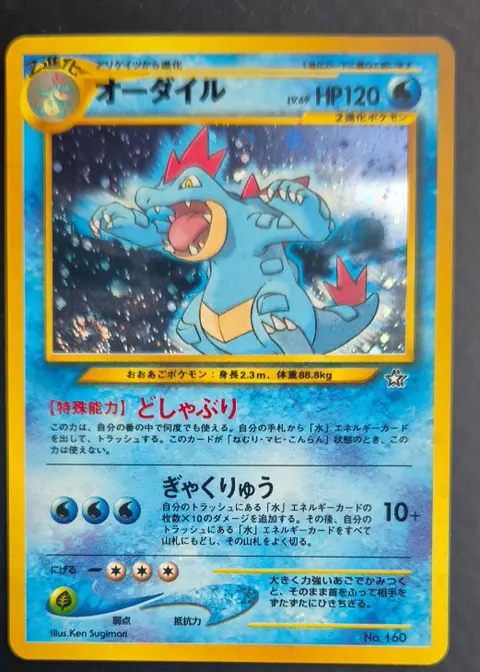
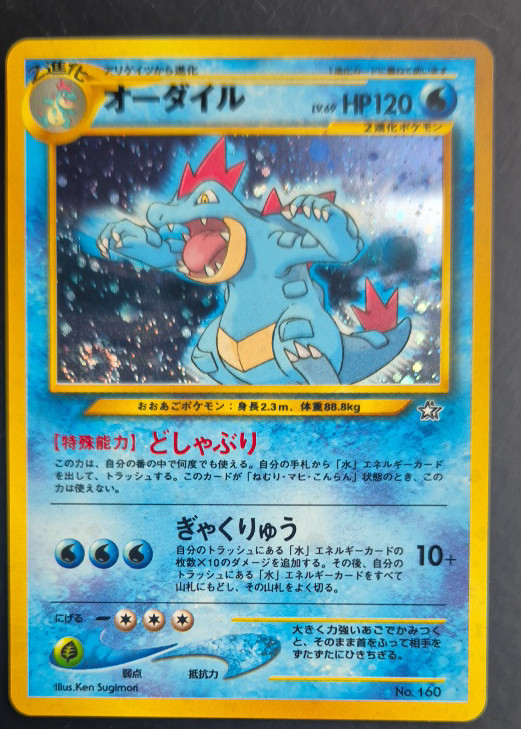
Feraligatr (Japanese: オーダイル, Ordile) is the final evolution of Totodile, the Water-type starter Pokémon from the Johto region introduced in Generation II. It is designed as a powerful, crocodilian predator and became one of the signature Johto starter evolutions, closely associated with the Gold, Silver, and Crystal era of Pokémon. The card art for this era is credited to Ken Sugimori, whose official creature illustrations defined the early Pokémon TCG aesthetic.
First released in Japan in the Neo Genesis set, known in Japanese as Gold, Silver, to a New World, on February 4, 2000. This card is Japanese No. 160, printed as a Rare Holo card in the Neo-era Japanese release.
- This card is a Japanese holographic print with card number No. 160 and is commonly associated with the Neo Genesis / Gold, Silver, to a New World era.
- Market references identify it as Rare Holo and note a release date of February 4, 2000.
- There is also a separate Japanese Feraligatr No. 160 from Neo Premium File 1, which can cause confusion for collectors because it shares the same Pokémon number but is not the same release.
Rarity and print run
- Tier
- Rare
- Print run
- Medium
- First printed in
- Neo Genesis (Japanese: Gold, Silver, to a New World)
- Demand
- High
- Supply
- Medium
- Holo rare from an early-2000 Japanese Neo-era set
- Graded high-end copies are meaningfully scarcer than raw copies
- Collectors also track the separate Neo Premium File version, which creates additional demand for both variants
- Vintage Japanese holo condition attrition reduces the number of strong mint copies
Collector notes
Condition. Check the front holofoil for scratching, edge whitening, and corner wear; Japanese holo cards from this era often show silvering on edges, light surface scratching, and back-side whitening. Centering matters strongly for grading, and any print lines, dents, or holo scratches can significantly reduce value.
Storage. Store in a penny sleeve inside a rigid top loader or semi-rigid holder, keep away from humidity and direct sunlight, and avoid repeated handling of the holo surface. For long-term preservation, use an archival binder sleeve or graded slab for high-grade copies.
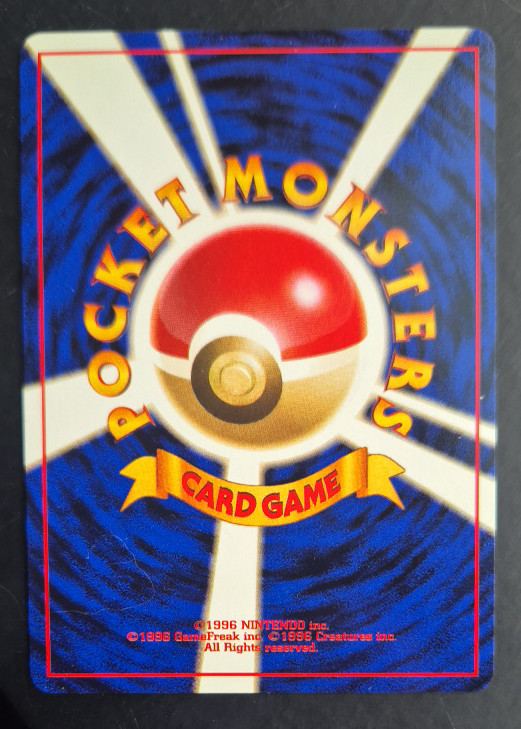
Authenticity. Authentic Japanese cards from this era should have crisp print quality, clean holo patterning, and period-correct cardstock. Watch for fuzzy text, dull or incorrect holo shine, mismatched font spacing, and poor cut edges; compare against known authentic Japanese Neo-era cards, especially because the Neo Premium File version can be mistaken for the standard Neo Genesis print.