Market outlook
Rising Outlook 7/10
Vintage WOTC holos continue to benefit from long-term collector demand, and rare variants such as 1st Edition and Prerelease-stamped copies tend to hold value well. Scarcity in gem-mint condition and the enduring popularity of the Fossil set support gradual upward pressure over time.[1][4]
Next months. Likely to remain firm to slightly higher, with the strongest performance in 1st Edition, Prerelease, and graded 9-10 copies.
Long term. Likely to continue appreciating gradually, especially for certified high-grade examples and unusual variants, though lower-grade unlimited copies should grow more slowly.
History
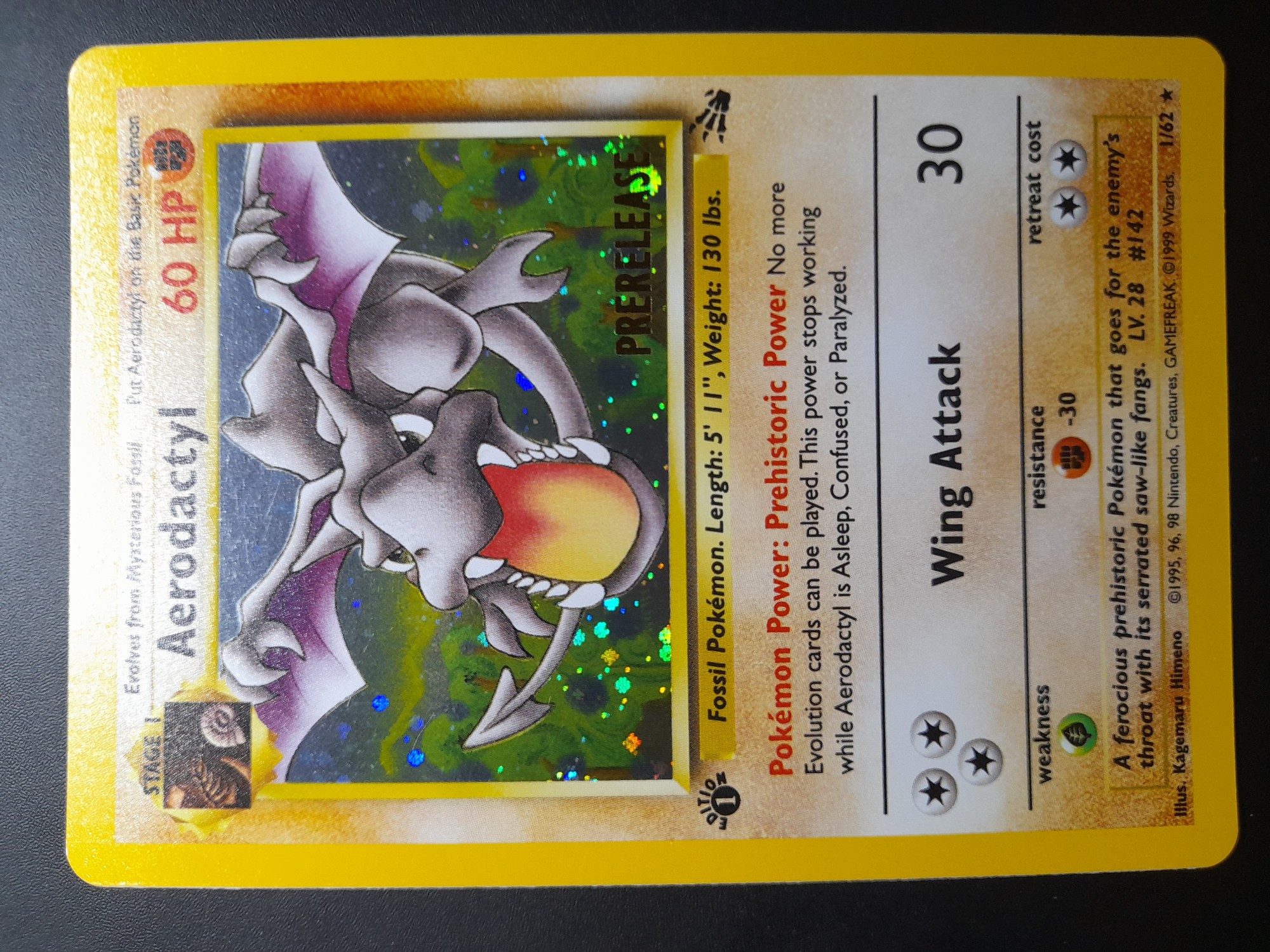
Aerodactyl is a Generation I Pokémon introduced in the original Pokédex as a revived prehistoric species, typically depicted as a flying, dinosaur-like fossil Pokémon. In the TCG, Fossil Aerodactyl is notable for its disruptive 'Prehistoric Power' ability, which prevents players from evolving Pokémon while Aerodactyl is in play, making it one of the most strategically memorable Fossil-era cards.[2] The card’s significance is also tied to early Wizards of the Coast-era collecting, where Fossil holos became iconic vintage chase cards.[1][2]
This card was first released in the English Fossil expansion in 1999 as card 1/62, with multiple contemporary release variants including 1st Edition, Unlimited, and Prerelease-stamped copies.[1][2]
- Elite Fourum documents five variants of Fossil Aerodactyl 1/62, including 1st Edition, Unlimited, Prerelease-stamped, and Employee-only versions.[1]
- TCGplayer identifies the card as 01/62, Holo Rare, with Fighting type and 60 HP, confirming it as the Fossil-era holo version.[2]
- The Prerelease version is distinguished by a 'PRERELEASE' stamp on the bottom right of the card, and the 1st Edition Prerelease version uses a Cosmos holofoil pattern instead of the standard Galaxy holofoil pattern.[1]
Rarity and print run
- Tier
- Rare
- Print run
- Low
- First printed in
- Fossil
- Demand
- High
- Supply
- Low
- Holo rare from a 1999 WOTC-era set
- 1st Edition and Prerelease-stamped versions are significantly scarcer than Unlimited
- High-grade copies are difficult to find due to black-border wear and holo scratching
- Elite Fourum notes five distinct variants, with the stamped and employee-only versions being especially collectible.[1]
Collector notes
Condition. Check the holofoil for scratches, print lines, and foil clouding; the black borders for edge wear, whitening, and corner fraying; and the surface for dents or pressure marks. On stamped copies, verify that the PRERELEASE stamp is centered, crisp, and consistent with known examples, since stamp placement and quality are key grading points.[1] Fossil holos are also vulnerable to silvering along edges and small manufacturing nicks.
Storage. Store in a soft penny sleeve plus a rigid top loader or semi-rigid holder, and keep away from humidity, heat, and direct sunlight. For stamped or high-grade copies, avoid repeated handling and consider direct placement into a graded card slab if long-term preservation is the goal.
Authenticity. Authentic Fossil Aerodactyl cards should show period-correct Wizards of the Coast print quality, with accurate font, border color, holo pattern, and back design. For Prerelease copies, verify the stamp location and style against known examples, and be cautious of added counterfeit stamps or altered holos. Because the card exists in several legitimate variants, buyers should confirm whether the copy is 1st Edition, Unlimited, Prerelease, or Employee-only before purchase.[1]
Sources: elitefourum.com, tcgplayer.com, pricecharting.com, pokedata.io, pokecardvalues.co.uk