Market outlook
Rising Outlook 7/10
Vintage Hall of Fame and integration-era cards generally trend upward over time, especially when associated with iconic sets like 1951 Bowman. Doby’s historical importance and the set’s enduring popularity support gradual appreciation, while high-grade population scarcity can amplify gains.[1][4][5]
Next months. Likely stable to modestly higher pricing, with the strongest movement in eye-appealing graded examples.
Long term. Likely gradual appreciation over 1-3 years, with top-grade copies outperforming lower-grade examples as vintage demand remains strong.
History
Larry Doby was the Cleveland Indians outfielder and a pioneering figure in Major League Baseball as the first Black player in the American League. He debuted in the majors in 1947, shortly after Jackie Robinson broke baseball's color barrier in the National League, and became a seven-time All-Star, World Series champion, and Hall of Famer. His significance extends beyond statistics: he helped integrate the American League and is widely recognized as one of baseball's most important civil-rights-era athletes.[4]
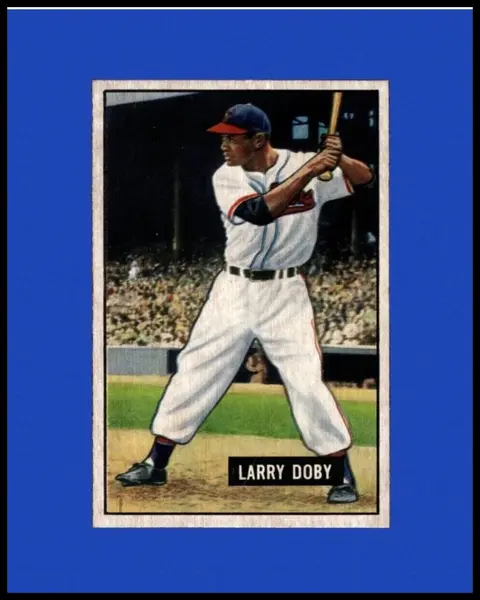
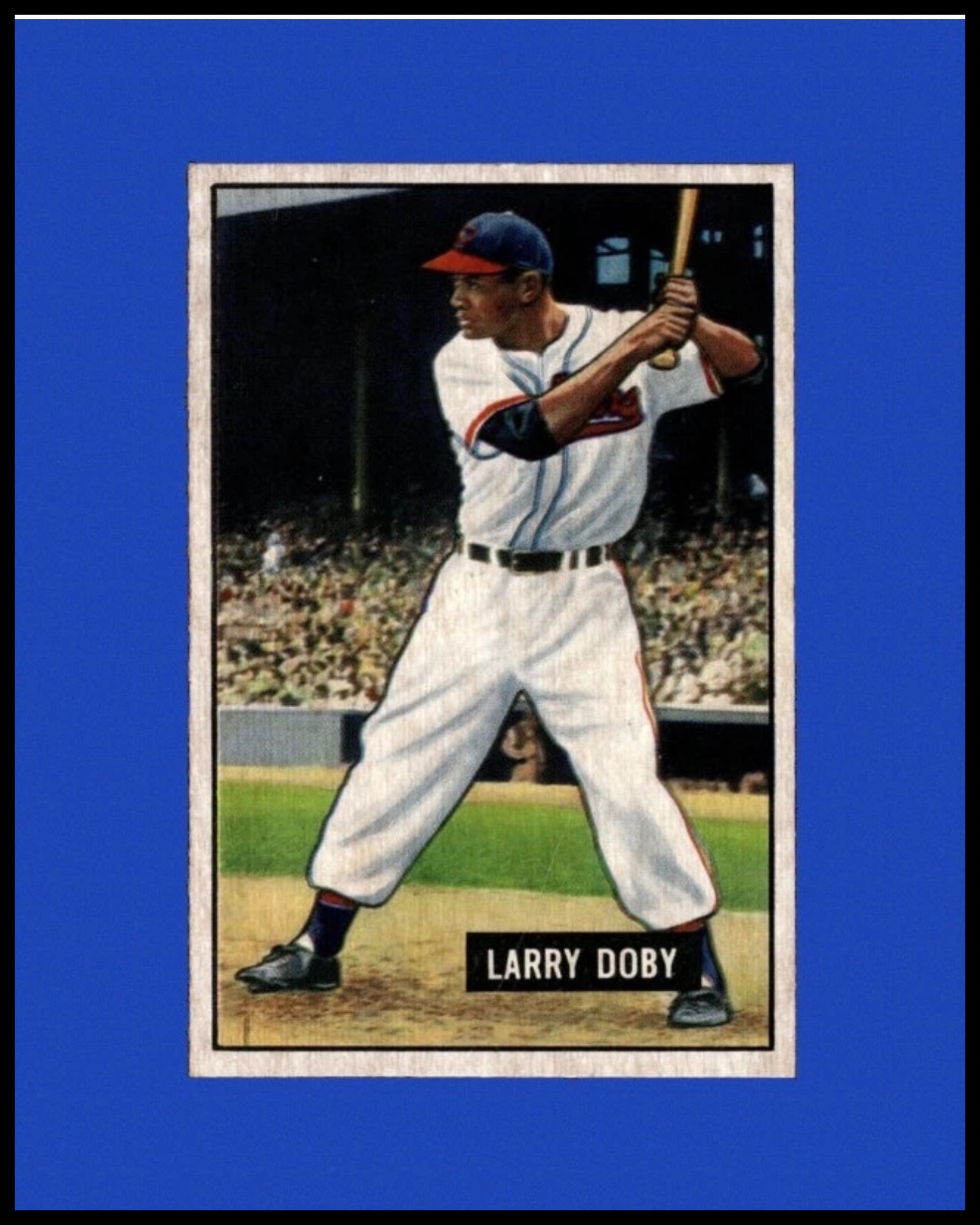
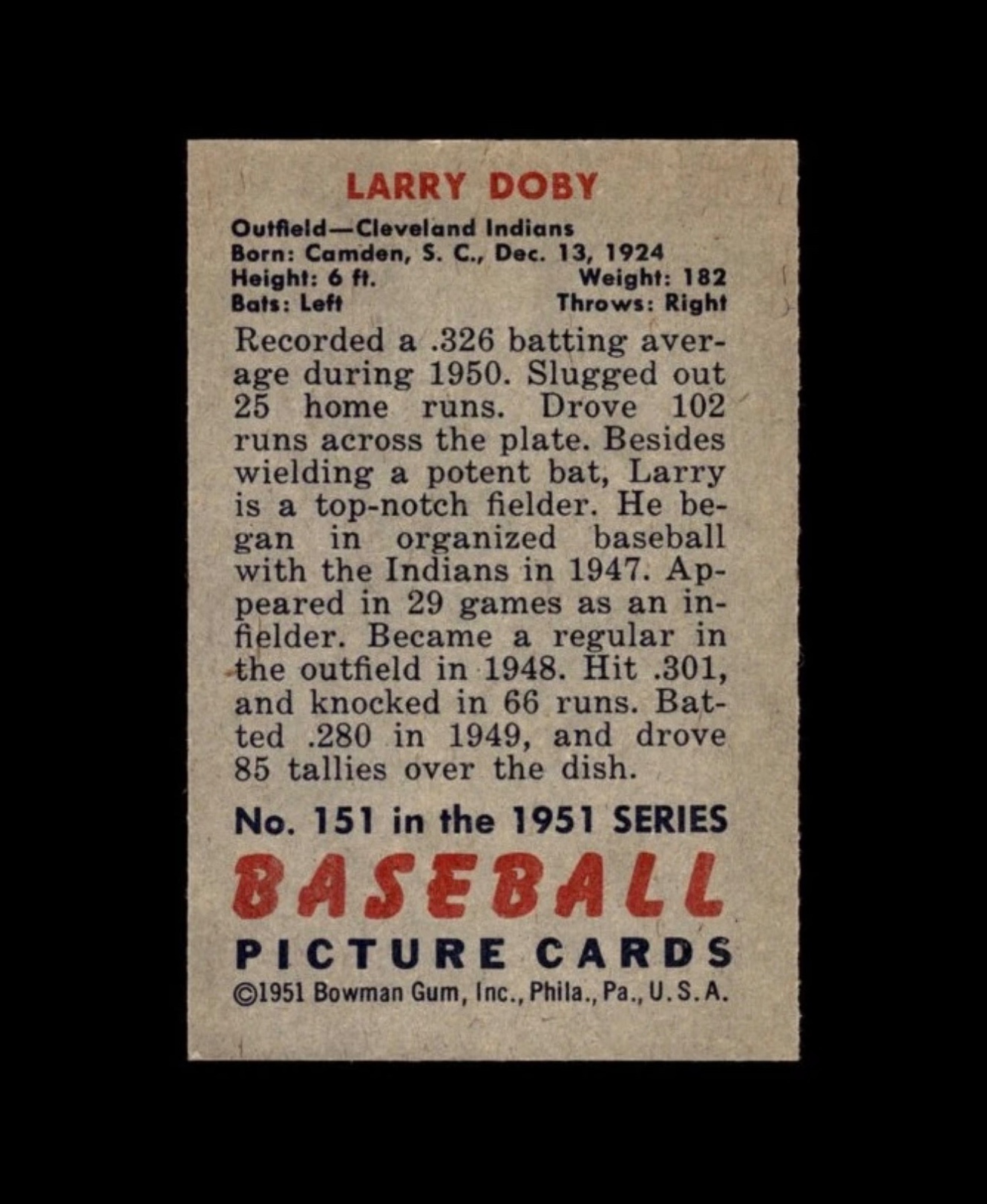
The card was first released in 1951 as part of the 1951 Bowman Baseball set, issued by Bowman in the United States. Card #151 appears in the standard 324-card checklist and is listed as 'Larry Doby - Cleveland Indians' in the set details.[1]
- This is Larry Doby's 1951 Bowman card, a post-integration-era card from one of Bowman’s most important and collectible sets.[1]
- The 1951 Bowman set introduced player names on the front and used color-photo-style artwork, with both vertical and horizontal card layouts.[1]
- Larry Doby's 1951 Bowman card is priced in modern guides as a desirable vintage Hall of Fame-era issue, with recent graded sales reported around the mid-hundreds in graded 5 and around $2,200 in graded 8.[2][5]
Rarity and print run
- Tier
- Common
- Print run
- High
- First printed in
- 1951 Bowman Baseball
- Demand
- High
- Supply
- Medium
- It is a base-card issue from a large 324-card 1951 Bowman set rather than a short print or high number.
- High-grade examples are much scarcer than raw copies because of centering, corner wear, and surface condition issues.
- Demand is elevated by Larry Doby's historical significance and Hall of Fame status.
Collector notes
Condition. Check centering, corner wear, edge chipping, surface scuffs, staining, and print registration. The 1951 Bowman issue is especially vulnerable to corner rounding and surface wear from decades of handling, and higher-grade copies can command a large premium due to strong eye appeal.[1][5]
Storage. Store in an acid-free penny sleeve and semi-rigid holder or top loader, keep away from heat, humidity, and direct sunlight, and avoid cleaning or pressing unless handled by a professional conservator. For long-term protection, use archival-grade materials and stable climate storage.
Authenticity. Verify the card stock, print quality, aging, and back text alignment against known authentic examples. Reprints often show overly sharp or modern printing, unnatural gloss, or incorrect paper feel. For a card with meaningful value in higher grades, third-party grading and authentication from a major grading company is strongly advisable.
Sources: throwbacksportscards.com, sportscardinvestor.com, americaspastime.com, psacard.com, sportscardspro.com