Market outlook
Stable Outlook 7/10
Recent market references show strong but uneven pricing, with raw and graded values remaining supported by character demand, yet not showing clear uniform acceleration across all venues.[2][4][5][7][8]
Next months. Expect relatively stable pricing with normal volatility in raw and graded examples, especially around high-grade sales and availability changes.
Long term. Over 1-3 years, the card is likely to remain a durable mid-to-high demand collectible, with the strongest upside concentrated in graded 10 and other top-grade copies.
History
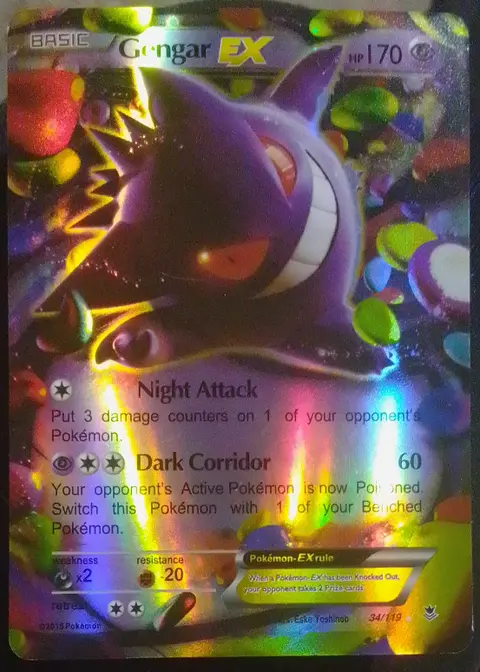
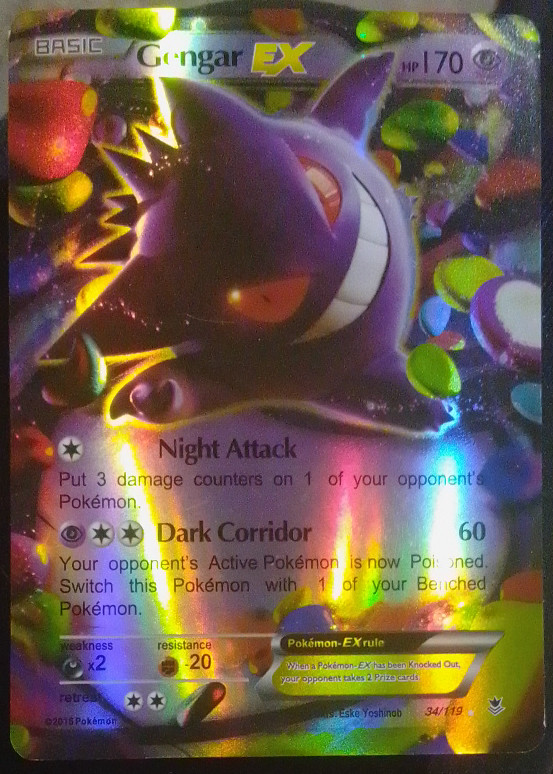
Gengar is a classic Ghost/Poison-type Pokémon introduced in the original Pokémon games and anime as the final evolution of Gastly, representing the franchise's long-running haunted-house and shadowy-trickster archetype. In the TCG, Gengar has historically been treated as a fan-favorite chase character with multiple collectible chase cards across eras, and the Gengar-EX from Phantom Forces continued that premium character-treatment in the XY era.[6][7]
This specific English Gengar-EX was first released in the Phantom Forces expansion in 2014; multiple market references identify Phantom Forces as the original set, with release timing in November 2014.[6][7]
- Phantom Forces includes multiple Gengar-EX printings/versions, with the Full Art version commonly identified as #114/119 and the standard version as #34/119; collectors often distinguish these as separate chase cards.[2][4][6]
- The full-art Gengar-EX is widely treated as one of the XY-era chase cards, with strong premium in high grades versus raw copies.[4][5][7][8]
- Population data shows substantial grading volume for Phantom Forces Gengar-EX cards, but gem-mint examples remain materially scarcer and command large premiums.[10]
Rarity and print run
- Tier
- Ultra Rare
- Print run
- High
- First printed in
- Phantom Forces
- Demand
- High
- Supply
- Medium
- Full Art Ultra Rare treatment
- High collector demand for Gengar as a flagship character
- Gem-mint copies are much scarcer than raw copies
- XY-era Full Arts were opened heavily, but clean centering and surface quality are harder to find
Collector notes
Condition. Check for whitening on edges and corners, holo scratching, surface dimples, centering, and print lines; Full Art cards also commonly show back-surface wear and edge chipping. XY-era Full Arts can lose grade quickly from minor silvering, dents, or factory roller marks.
Storage. Store in a penny sleeve inside a rigid top-loader or card saver for raw copies, and use humidity-controlled storage away from light and heat. For graded or long-term holdings, keep the card protected from pressure, bending, and abrasion, and avoid repeated handling without gloves or clean hands.
Authenticity. Verify the correct card number, font clarity, texture/foil pattern consistency, and sharp printing on the artwork and text. Counterfeits often have dull foil, incorrect saturation, poor edge cuts, or blurry text; the Full Art version should show the full-art EX treatment with correct set symbols and exact XY Phantom Forces layout.
Sources: pokescope.app, getripdex.com, pricecharting.com, sportscardinvestor.com, cardseer.io