Market outlook
Stable Outlook 7/10
Demand for flagship rookie cards of Hall of Fame players is persistent, but this is a common card in lower grades, so price growth is usually gradual rather than explosive. High-grade copies should remain more resilient than raw copies because condition scarcity supports premium pricing.[1][5]
Next months. Expect modest price movement with stronger performance in graded 9 and graded 10 than in raw or low-grade copies.
Long term. Over 1-3 years, the card should remain collectible and liquid, with the best upside concentrated in high-grade examples and well-registered, well-centered copies.
History
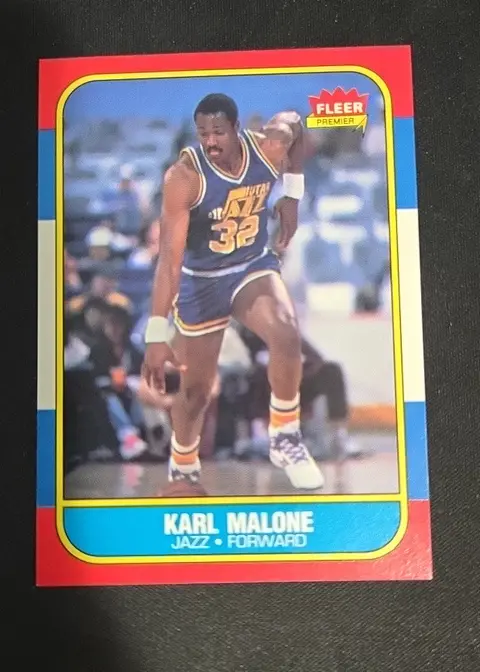
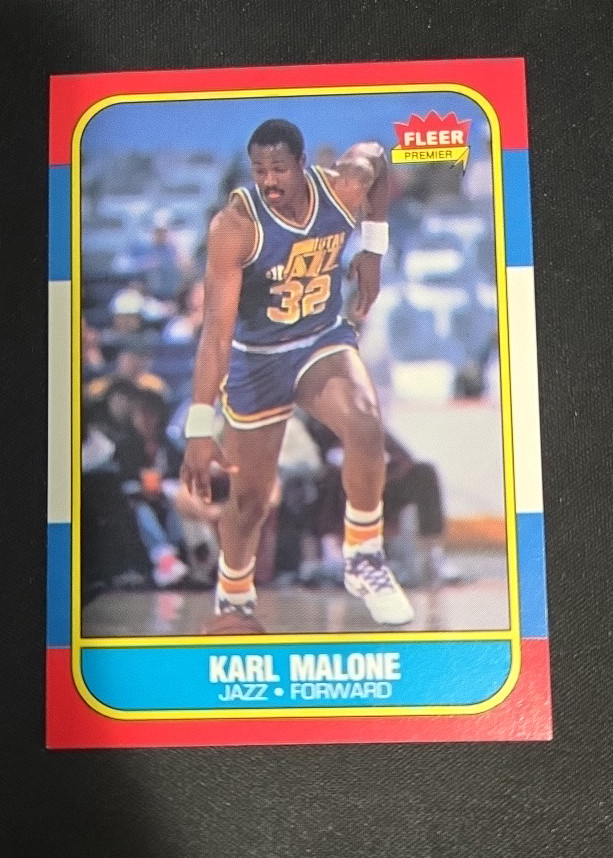
Karl Malone, nicknamed "The Mailman," is one of the most iconic power forwards in basketball history. He starred at Louisiana Tech before being selected 13th overall in the 1985 NBA Draft by the Utah Jazz. His combination of durability, physical scoring, rebounding, and longevity made him a Hall of Famer and one of the defining players of the NBA's 1980s and 1990s era. His rookie-year Fleer card is significant because it comes from the landmark 1986-87 Fleer basketball set, the first mainstream licensed NBA trading card set of the modern hobby era, and it remains one of his most collected cards.[1][4][6]
This card was first released in the 1986-87 Fleer Basketball set, distributed in packs during 1986-87 in the United States.[1][4][6]
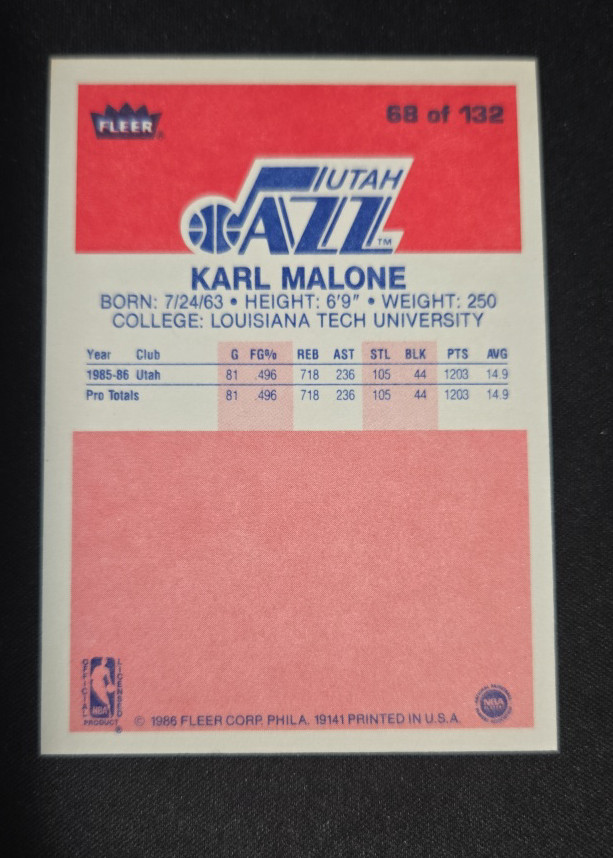
- Card #68 is widely recognized as Karl Malone's rookie card in the 1986 Fleer set.[1][4][6]
- The 1986-87 Fleer basketball set is a cornerstone modern-era basketball release and helped establish rookie-card demand for stars like Malone.[4][6]
- Market data shows strong collector interest in high-grade examples, with graded 10 copies selling for roughly the high-thousands on recent price guides and sales trackers.[1][5]
Rarity and print run
- Tier
- Common
- Print run
- High
- First printed in
- 1986-87 Fleer Basketball
- Demand
- High
- Supply
- Medium
- The card itself is not rare in raw form because it comes from a mainstream, widely distributed flagship set.
- High-grade examples are much scarcer due to centering and black-border wear.
- Gem-mint copies are difficult to obtain relative to demand, which creates scarcity at the top of the grading scale.
Collector notes
Condition. Check centering first, since 1980s Fleer basketball is notorious for off-center cuts. Also inspect the black borders for chipping, surface scuffs, corner whitening, print dots, and edge wear. High-grade examples are especially sensitive to small flaws because the design shows wear easily.[1][5]
Storage. Store the card in a penny sleeve and rigid top loader or card saver, keep it away from humidity and direct light, and avoid frequent handling. For long-term preservation, use an archival-safe binder or graded slab if professionally authenticated and graded.
Authenticity. Verify the exact 1986-87 Fleer design, back text, card stock, and print quality. Reprints may show sharper modern printing, incorrect gloss, or inconsistent colors. For a valuable copy, third-party grading from graded, graded, graded, or graded is the strongest authentication route.[1][5]
Sources: sportscardspro.com, collectibles.com, sportscardinvestor.com, psacard.com, cardladder.com