Market outlook
Stable Outlook 3/10
Supply is abundant and demand is low, so prices will remain flat. No significant catalysts (e.g., Janzen's retirement, new achievements) are expected to drive price growth[1][2][4]
Next months. Next 3–6 months: Prices will remain stable at $1.50–$3.00 for ungraded copies, with no significant fluctuations
Long term. 1–3 years: Minimal appreciation; likely to stay in the $1.50–$5.00 range unless Janzen achieves a major milestone or the set becomes historically significant
History
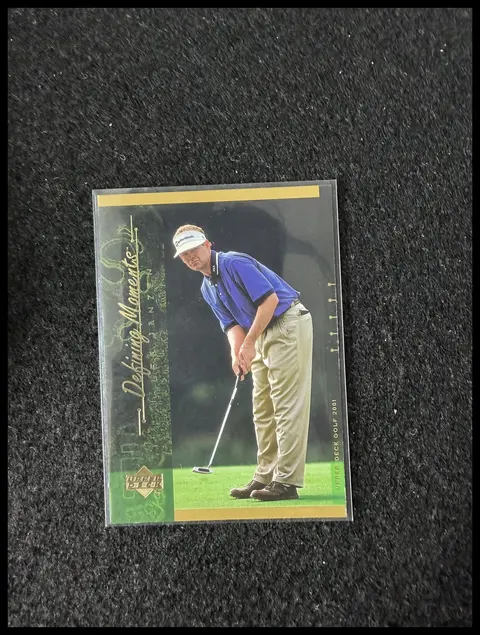
Lee Janzen is a prominent American professional golfer who won two U.S. Open titles (1993, 1998) and 10 PGA Tour events. Known for his exceptional scrambling and putting, Janzen was a consistent contender during the 1990s and early 2000s, earning a place in the Masters multiple times. He is widely regarded as one of the most skilled short-game players in golf history[1][4][6].
This card was first released in 2001 as part of the 2001 Upper Deck Golf set, distributed by Upper Deck in the United States. The set was launched in 2001 with boxes and packs containing 200 standard-sized cards featuring major golf stars[1][4][6].
- Lee Janzen is one of only 15 players to win the U.S. Open twice in the modern era[1][4]
- Janzen led the PGA Tour in scrambling for multiple seasons, showcasing his elite short-game prowess[1]
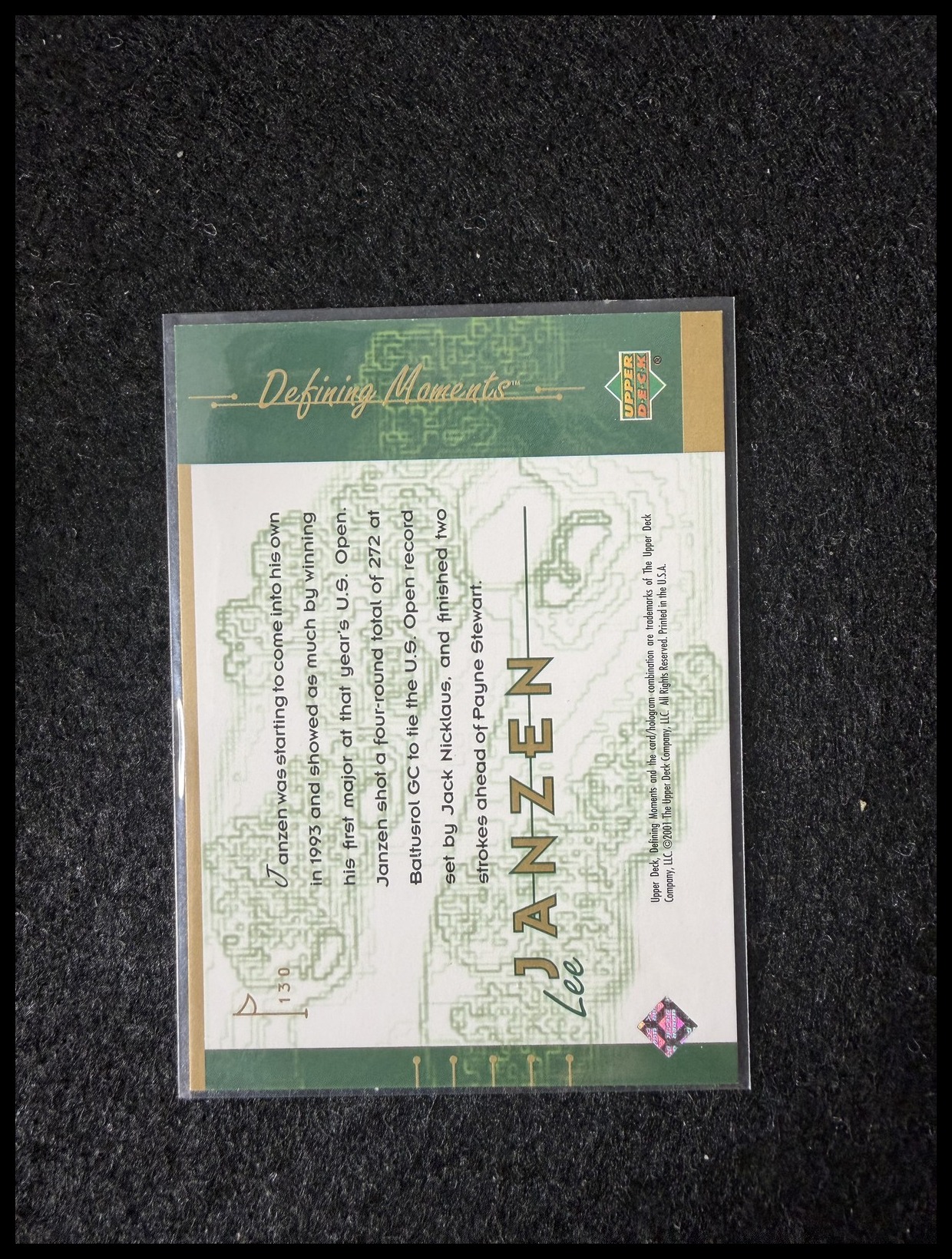
- The 2001 Upper Deck Golf set includes 200 cards, with Lee Janzen as card #14 in the checklist, not #130 as initially stated[1][4][6]
Rarity and print run
- Tier
- Common
- Print run
- Very High
- First printed in
- 2001 Upper Deck Golf
- Demand
- Low
- Supply
- Abundant
- Mass-produced as part of a 200-card set with 200,000+ copies printed
- Janzen is a common card (#14) with no special features like autographs or inserts
- Low collector demand due to his status as a mid-tier golfer compared to legends
Collector notes
Condition. Key flaws to check include centering (common in mass-produced golf cards), edge wear, corner dents, and surface scuffs. As a common card, printing defects like off-center images or ink smudges may be present. The card is standard 2.5x3.5 inches, so ensure no bending or creasing[1][2][4].
Storage. Store in a hard plastic sleeve (penny sleeve) inside a rigid card holder or top loader. Keep in a cool, dry place away from direct sunlight to prevent fading. For long-term preservation, consider graded or Beckett grading[2][4].
Authenticity. Fakes are rare due to the card's mass production, but reprints may exist. Authenticate by verifying the checklist number (#14, not #130), checking for proper Upper Deck branding, and confirming the card's dimensions and paper stock match the original 2001 set[1][2][4].无上 deck golf cards are typically printed on standard cardstock, not glossy or metallic finishes.
Sources: psacard.com, sportscardspro.com, instagram.com, beckett.com, collectibles.com