Market outlook
Rising Outlook 9/10
The card benefits from enduring Hall-of-Fame-era demand despite Pete Rose's controversial status, because collector interest is driven primarily by its place as his only recognized rookie card and by the strong vintage baseball market. High-grade supply remains thin relative to demand.[1][2][7]
Next months. Prices for authenticated, eye-appealing copies are likely to remain firm, with stronger performance in mid- and high-grade examples than in low-grade or altered copies.
Long term. Over 1-3 years, the card is likely to continue appreciating selectively, led by scarce high-grade examples and verified authentic copies, while lower-grade copies should remain relatively liquid but less volatile.
History
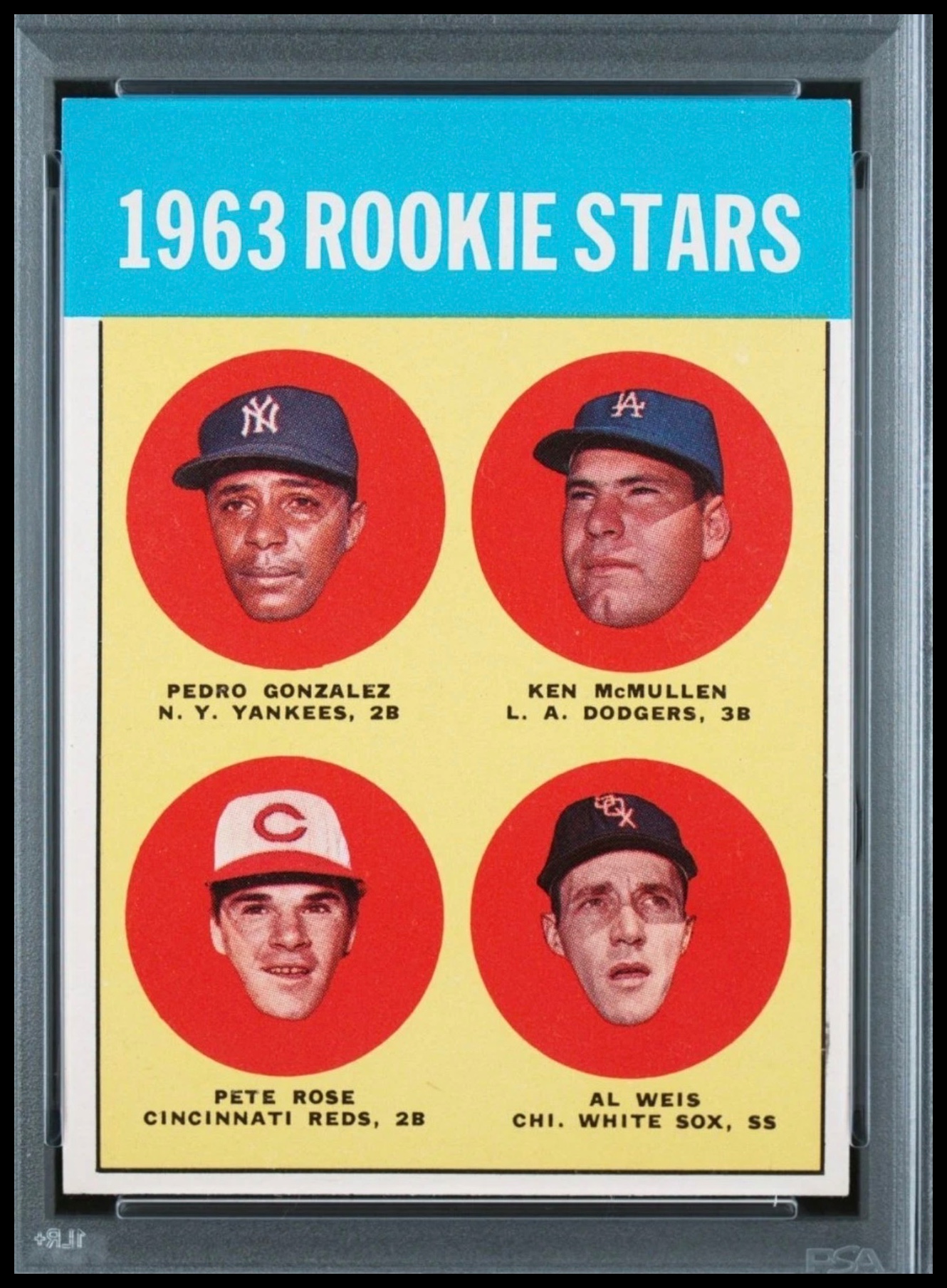
This card features four 1963 rookie players: Pete Rose, who became Major League Baseball's all-time hits leader and the card's primary draw; Pedro Gonzalez, an infielder with the Cincinnati Reds; Ken McMullen, a third baseman who later became an All-Star and World Series participant; and Al Weis, an infielder who later won a World Series with the 1969 Mets. graded identifies this as the only recognized rookie card of Pete Rose, which gives the card enduring historical significance in the vintage baseball card market.[1]
First released in 1963 as part of the 1963 Topps Baseball set, issued by Topps in the United States.[1][8]
- It is widely treated as Pete Rose's key rookie card and graded describes it as his only recognized rookie card.[1]
- The card combines four players on one horizontal rookie-stars layout, a common Topps multi-player rookie format of the era.[1][8]
- Because of Pete Rose's stature, the card is among the most important and heavily counterfeited cards in the 1963 Topps issue.[3]
Rarity and print run
- Tier
- Common
- Print run
- Very High
- First printed in
- 1963 Topps Baseball
- Demand
- Very High
- Supply
- Medium
- The base issue is common as a 1963 Topps card and was widely distributed.
- High-grade examples are scarce because centering and edge wear are difficult to avoid.
- Counterfeits and altered copies complicate the market, increasing the premium on authenticated copies.
Collector notes
Condition. Check centering, corner wear, edge chipping, print snow, surface scratches, and tilt. This issue is especially prone to upper-edge wear on the blue border area, and centered high-grade examples are difficult to find. Lower-grade copies often show rounded corners, corner dings, back staining, and surface wear from handling.[3][1]
Storage. Store in a penny sleeve inside a rigid top loader or semi-rigid holder, and keep it in a cool, dry, stable environment away from sunlight and humidity. For higher-value graded or raw examples, use archival materials and avoid repeated handling because surface wear and corner damage materially affect value.[1][3]
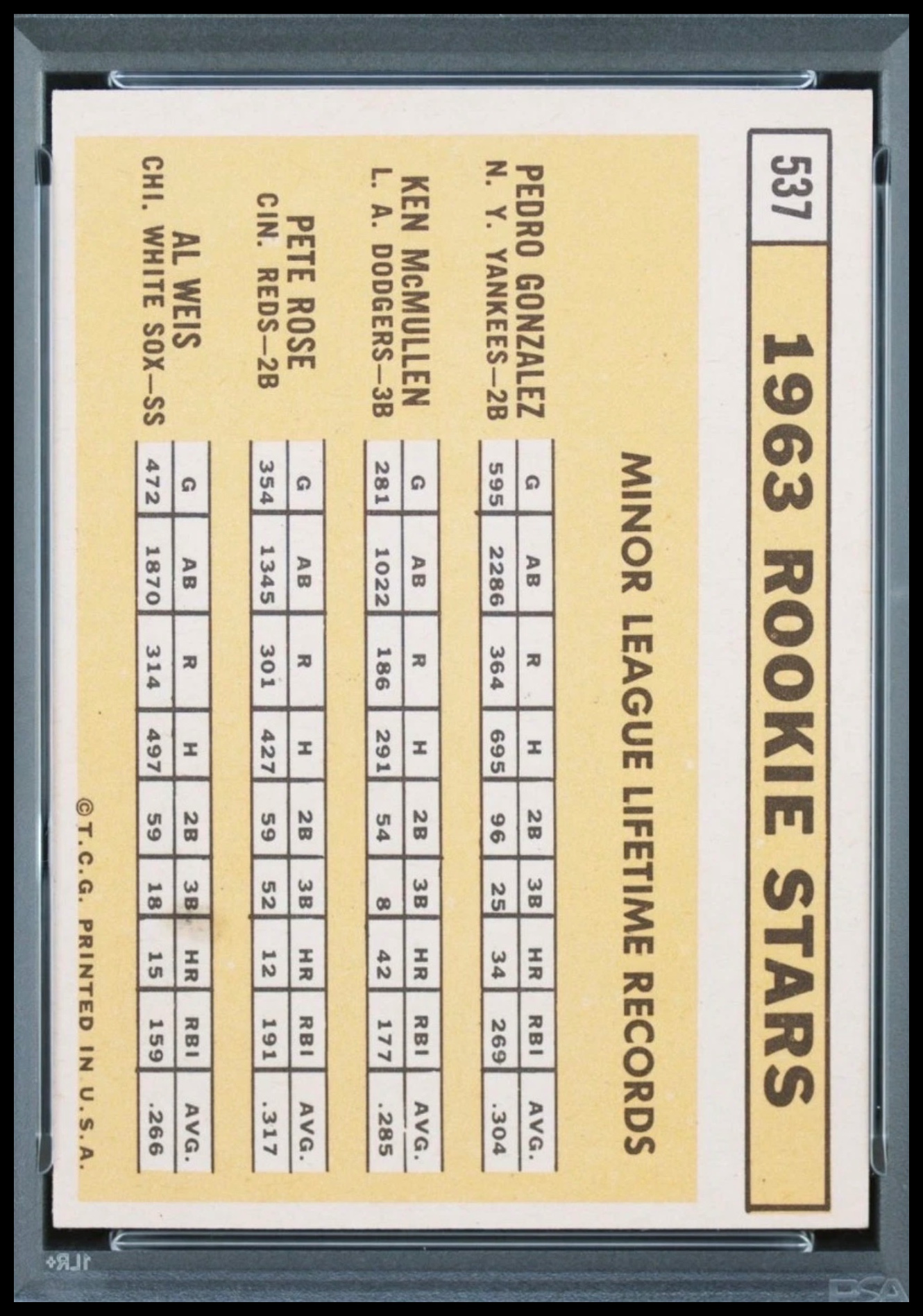
Authenticity. Counterfeit detection should focus on the black outline details on Pete Rose's hat, the Cincinnati logo outline, card stock thickness, back color tone, pixelation in the portraits, and overall print sharpness. Authentic examples should not appear thin or see-through under light, and the card should show consistent vintage print texture rather than modern digital-looking dots or overly perfect centering. graded-linked counterfeit guidance notes that some fake examples may also show a thin black line around the outside of Rose's white hat and a missing black line on the Cincinnati logo.[3]
Sources: psacard.com, sportscardspro.com, sportscardinfo.wordpress.com, mlbshop.com, alt.xyz