Market outlook
Stable Outlook 6/10
Price support comes from set nostalgia, Japanese exclusivity, and collectible foil presentation, but abundance relative to chase cards and the card’s Uncommon rarity should keep growth moderate rather than explosive.[4][7][8]
Next months. Likely to remain near current trading levels with small fluctuations based on grade and listing quality.
Long term. Over 1-3 years, gradual appreciation is possible, especially for high-grade copies, but the card is unlikely to outperform the set’s major chase cards by a wide margin.
History
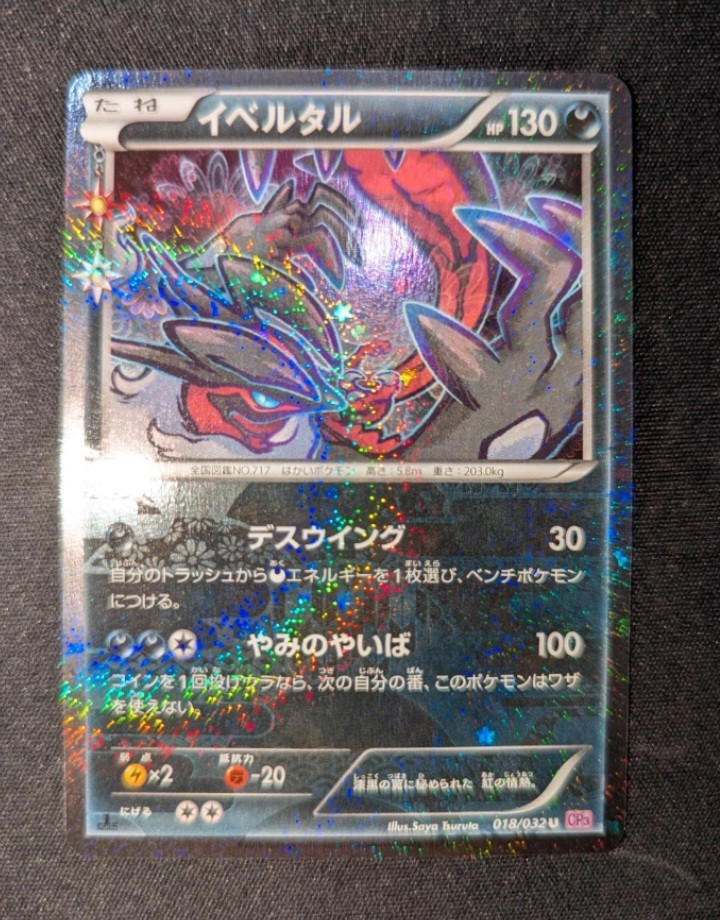
Yveltal is a Legendary Pokémon introduced in the Kalos region and first appeared in the video games Pokémon X and Y as the counterpart to Xerneas and Zygarde. In the TCG, Yveltal has been used repeatedly on Darkness-type cards because of its association with destruction, absorption of life force, and the Dark-type identity that the Pokémon franchise assigns to it.[14]
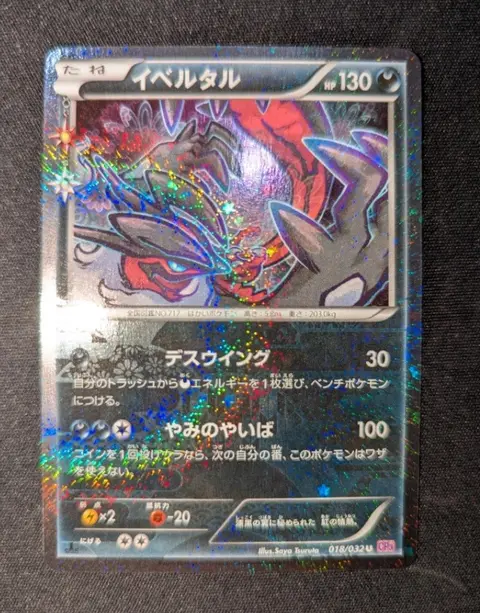
This card was first released in Japan in the PokéKyun Collection concept pack on January 29, 2016; some market databases also list the set’s release as June 1, 2016, but the set-specific Pokémon card database and product listings identify January 29, 2016 as the Japanese release date.[3][15][13]
- PokéKyun Collection is a 32-card Japanese mini set from the XY BREAK era, and all cards in the set are holofoil.[4][15]
- Yveltal #018/032 is cataloged as an Uncommon card and is one of the non-secret regular cards in the set.[3][8][13]
- This print is notable for being part of a Japan-only mini set with strong collector demand because of its cute 'PokéKyun' theme and foil treatment.[4][15]
Rarity and print run
- Tier
- Uncommon
- Print run
- Low
- First printed in
- PokéKyun Collection (CP3)
- Demand
- Medium
- Supply
- Medium
- Japan-only release
- Mini set with only 32 cards
- All cards are holofoil, which increases collector interest
- Demand is supported by Yveltal being a well-known Legendary Pokémon
Collector notes
Condition. Check for edge whitening, corner wear, surface scratches, holo scratches, print lines, and centering; Japanese foil cards from small mini sets often show visible scratches on the front and minor edge wear from handling.[4][1][2]
Storage. Use a penny sleeve plus a rigid top loader or card saver, store upright in a cool dry place, and avoid stacking with pressure because holo scratches and edge wear materially affect value on this card.[1][2]
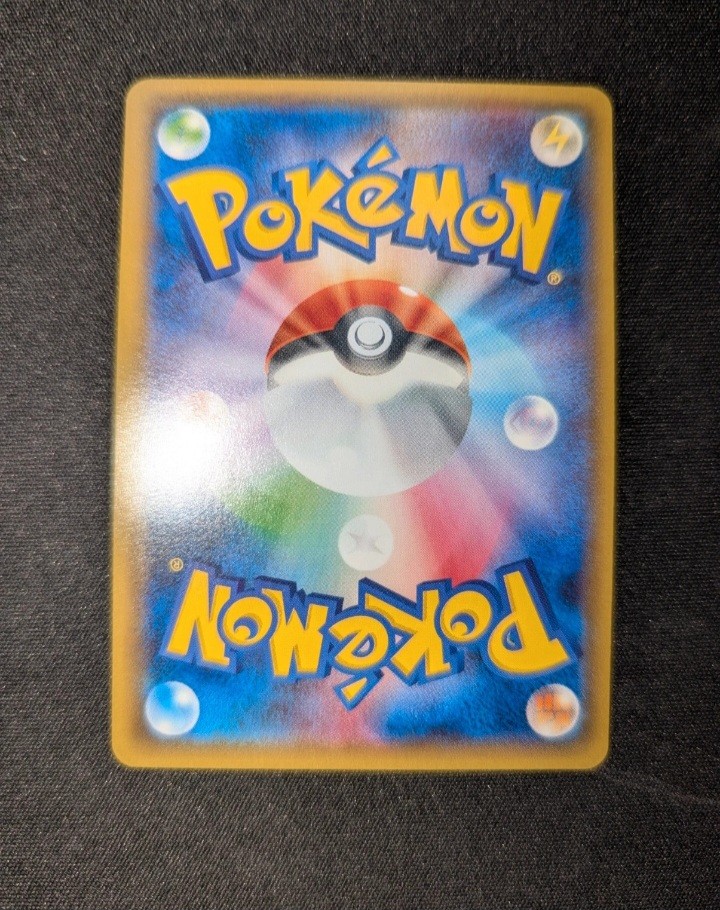
Authenticity. Authentic copies should match Japanese print quality, correct CP3 numbering 018/032, and the foil pattern used for PokéKyun Collection; fakes often show blurry text, incorrect font weight, poor holographic shine, or off-center borders. Cross-checking the exact set number and foil style against reputable catalog images is the safest authentication step.[13][3][4]
Sources: pricecharting.com, cardholo.app, serebii.net, pokevault.com, snkrdunk.com