Market outlook
Stable Outlook 3/10
Common cards from widely opened base-era sets usually trade in a narrow band. Any upside is mostly from nostalgia, language-specific collecting, and very high-grade population premiums.
Next months. Likely to remain price-stable with small fluctuations around low raw-card values and modest graded premiums.
Long term. Expected to stay stable to slightly rising at the top end if gem-mint and language-collecting demand continues, but raw copies should remain inexpensive.
History
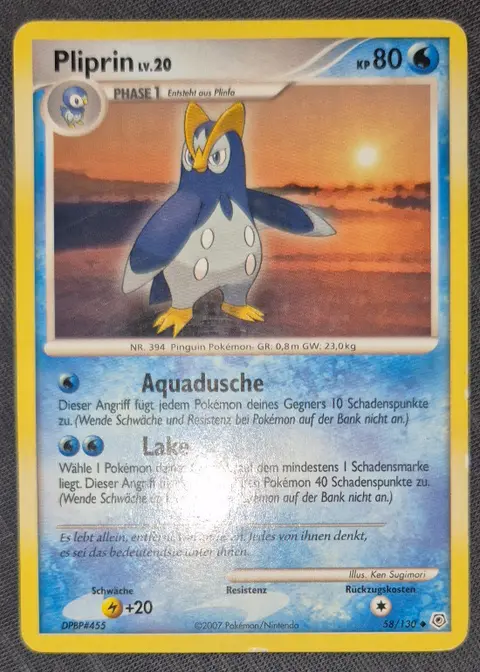
Prinplup is the Stage 1 Water-type evolution of Piplup in the Pokémon franchise, introduced in Generation IV. It represents the mid-evolution form between Piplup and Empoleon and is notable for its royal, penguin-inspired design and role in the Sinnoh Pokédex. In the TCG, it commonly appears as a support-stage Pokémon from the Diamond & Pearl era, reflecting the early DP-era gameplay style and artwork by Ken Sugimori.
This card was first released in the Diamond & Pearl expansion in 2007; the English set released on May 23, 2007, and the German-language version was released as Diamant & Perl in 2007, with a listed release date of July 4, 2007 for the German print.
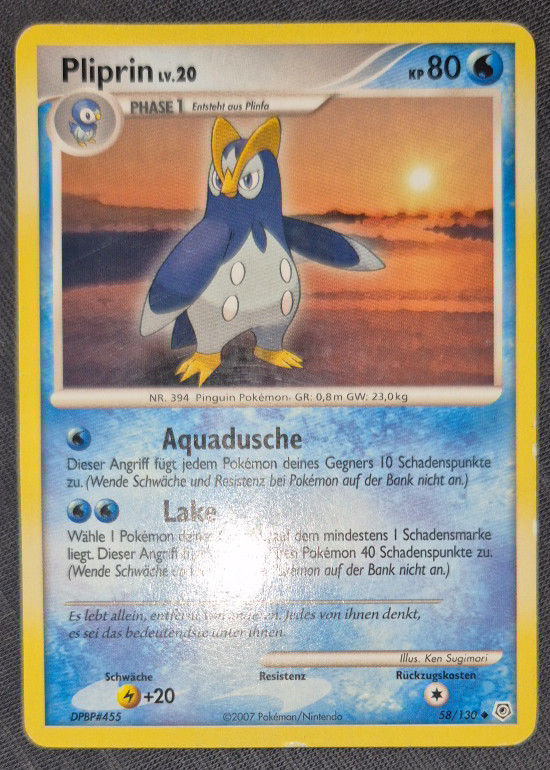
- Card number 58/130 in the Diamond & Pearl set.
- The German name is Pliprin, not Prinplup.
- Artwork is credited to Ken Sugimori.
- The card is a Stage 1 Water-type Pokémon with 80 HP.
- The Diamond & Pearl set was released in multiple languages, including German.
Rarity and print run
- Tier
- Common
- Print run
- Very High
- First printed in
- Diamond & Pearl (Diamant & Perl in German)
- Demand
- Low
- Supply
- Abundant
- Common cards were printed in large quantities.
- Set completion demand exists, but only modestly.
- German-language versions are less common than English in some markets, yet still not scarce for this set.
Collector notes
Condition. Common wear points include edge whitening, corner dings, surface scratches, print lines, and centering issues. For this card, look closely at the blue border wear, holo/reverse pattern scuffing if applicable, and any signs of binder rings or play wear.
Storage. Store in a penny sleeve and rigid top loader or semi-rigid holder, kept in a cool, dry place away from sunlight. For long-term storage, use acid-free sleeves and avoid stacking loose cards.
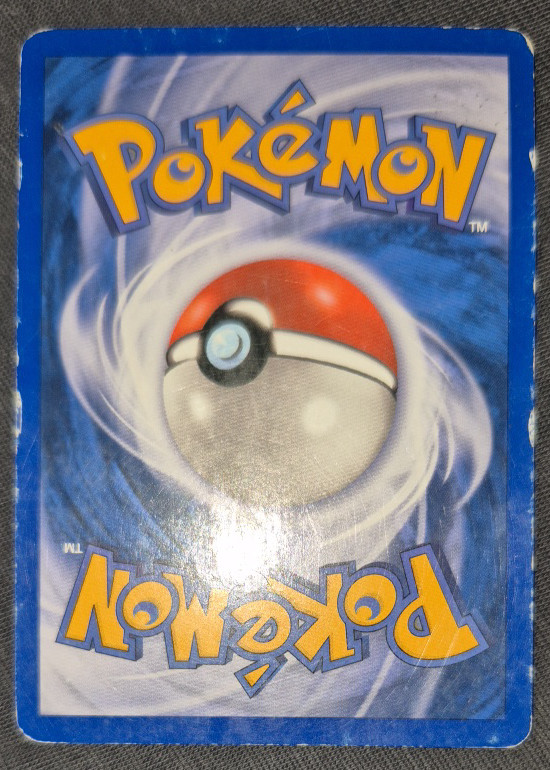
Authenticity. Authentic copies should match the correct German text, set numbering, font, and print quality. Check for blurry text, off-color borders, incorrect energy symbols, or misaligned backs. German-language fakes often fail on the accenting, spacing, or card stock feel.
Sources: pokemonkarte.de, pricecharting.com, serebii.net, bulbapedia.bulbagarden.net, pkmncollectors.com