Market outlook
Stable Outlook 7/10
The card remains one of the strongest modern Pokémon chase cards, with frequent sales and sustained collector interest. However, the large graded population and substantial available supply limit scarcity-driven appreciation. German copies may show more uneven pricing because fewer transactions and a smaller buyer base make individual sales less representative.
Next months. Over the next 3-6 months, prices are likely to remain volatile but broadly stable, with strong English graded 10 copies potentially holding around the low-thousands-of-dollars range and German copies continuing to trade at a meaningful discount. Exceptional German copies may outperform ordinary raw copies if graded and marketed to European collectors.
Long term. Over 1-3 years, the card has favorable long-term collector prospects because of its artwork, character popularity, and status as a premier Sword & Shield chase card. Moderate appreciation is plausible if the Pokémon market strengthens, but returns are unlikely to be linear because supply is high. English top-grade copies have the strongest liquidity; German copies should be treated as a more specialized, less liquid collectible.
History
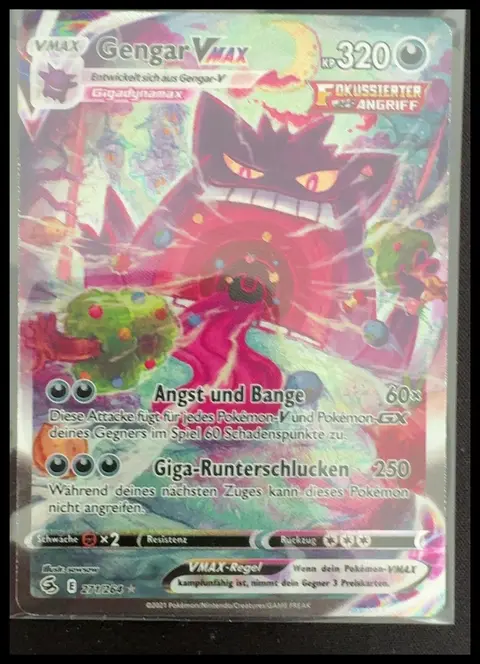
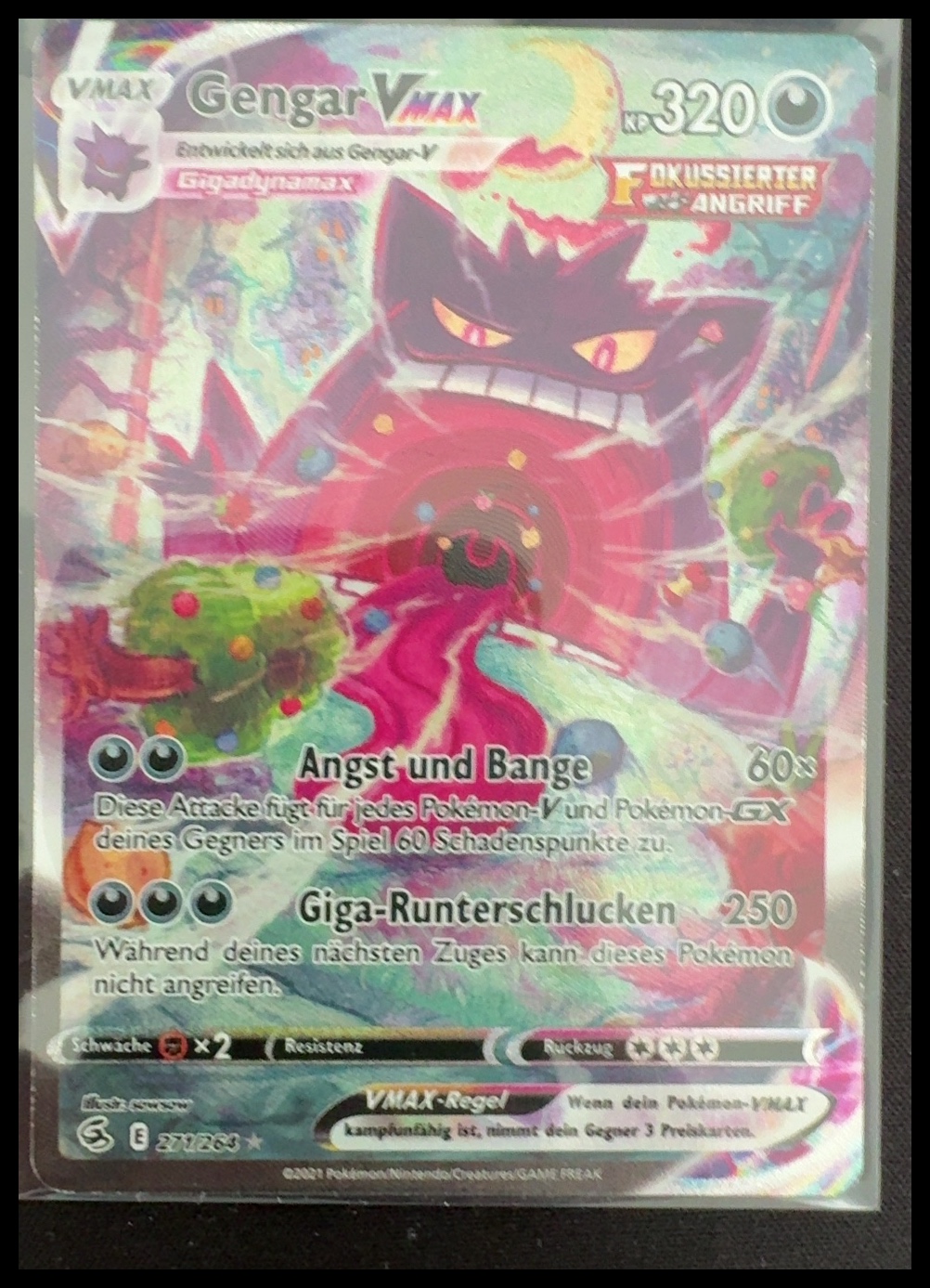
Gengar is a Ghost/Poison Pokémon introduced in the first-generation Pokémon games. It is the final evolutionary stage of Gastly and Haunter and is known for hiding in shadows, frightening people, and mischievous behavior. This card depicts Gengar in its VMAX form, a Gigantamax transformation associated with Pokémon Sword and Shield. The artwork shows Gengar opening its enormous mouth as a dark, dramatic alternate-art scene.
Gengar VMAX 271/264 was first released in the international Pokémon TCG Sword & Shield—Fusion Strike expansion in November 2021. The German-language version was released in the German localization, Fusionsangriff, in 2021. The card is an alternate-art Secret Rare illustrated by sowsow and has 320 HP.
- It is card 271/264, making it a Secret Rare printed beyond the set's stated 264-card numbering.
- It is one of the most recognized and heavily collected alternate-art cards from the Sword & Shield era.
- The card is a Darkness-type VMAX that evolves from Gengar V and has the attacks Panicking Strike and Giga Impact.
- Market databases report tens of thousands of graded English copies, indicating strong demand but substantially more supply than many older chase cards.
- German copies generally sell for less than equivalent English copies, while language, condition, centering, and grading have a major effect on value.
Collector notes
Condition. Inspect the front for whitening, edge chipping, scratches in the holo layer, print lines, surface dents, roller marks, corner wear, off-centering, and texture damage. Gengar VMAX 271/264 is particularly sensitive to centering and surface flaws because graded 10 demand is strong. Examine the back corners and borders under angled light, and distinguish factory print defects from post-opening damage. For German copies, confirm that the language is German and that the card number, expansion symbol, holographic texture, and typography match an authentic Fusionsangriff printing.
Storage. Place the card in a clean inner sleeve followed by a rigid semi-rigid holder or quality toploader. Use archival, PVC-free materials, keep the card upright in a dry temperature-stable environment, and avoid direct sunlight, heat, humidity, pressure, and frequent handling. For valuable copies, use a reputable grading service and store the slab in a protective sleeve or case.
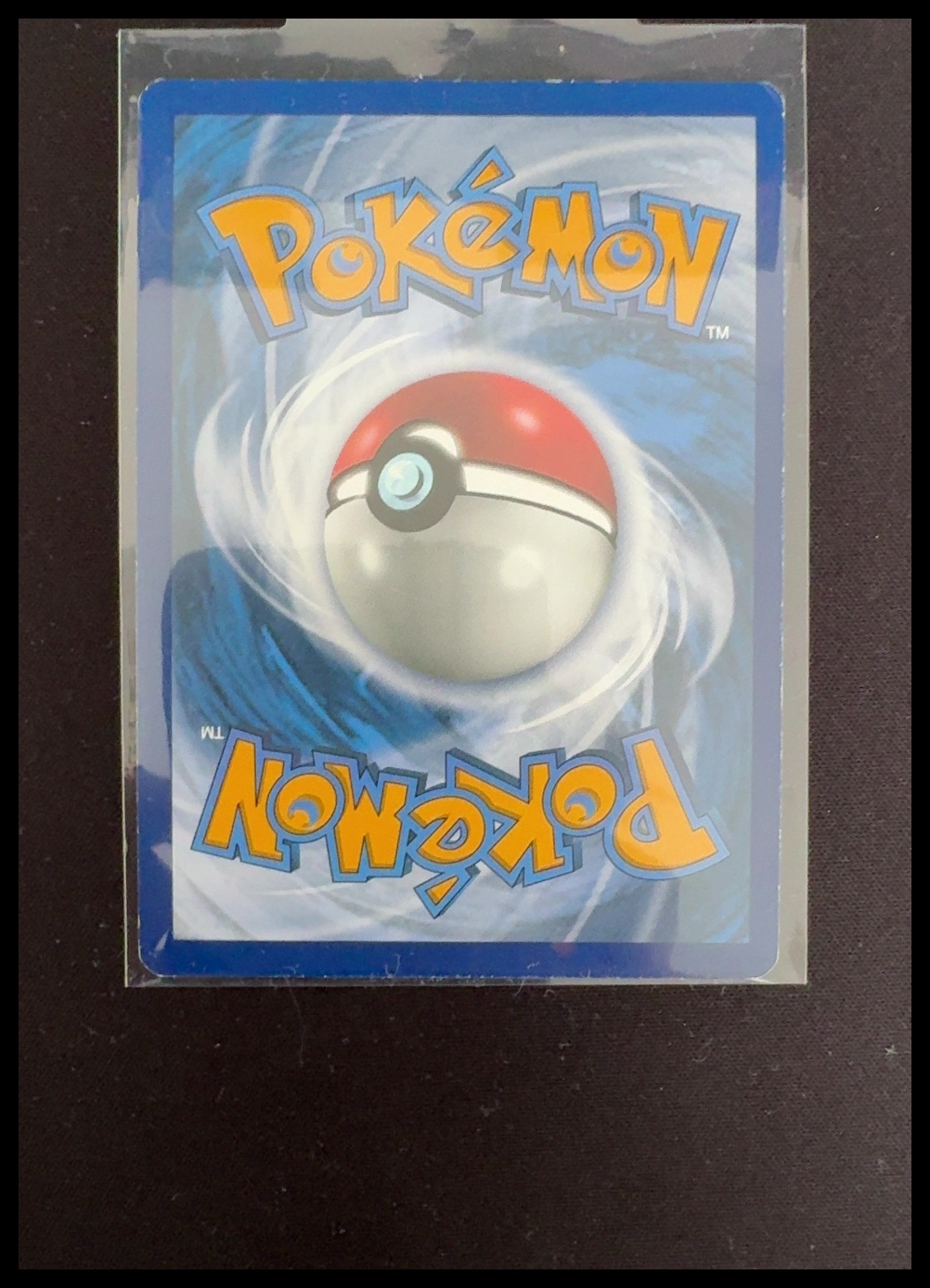
Authenticity. Check for accurate holofoil texture, crisp microprinting, correct Pokémon and set symbols, proper German text, consistent borders, and the expected card thickness and blue-backed Pokémon TCG pattern. Compare the card with verified scans from the same language and set. Warning signs include overly smooth or incorrect texture, blurry text, incorrect fonts, washed-out colors, irregular borders, wrong gloss, unusual light transmission, or a card that feels too thin or flexible. For high-value purchases, obtain clear front-and-back photographs, verify seller history, and consider third-party authentication or grading.