Market outlook
Stable Outlook 7/10
Recent sales show sustained high demand and strong prices for both raw near-mint and professionally graded copies, but the card has also experienced wide price dispersion and a large modern-era supply base. The most likely near-term pattern is volatility around a broadly stable elevated price level rather than a straight-line rise.
Next months. Over the next 3-6 months, raw near-mint copies are likely to remain in the approximate high-hundreds range, while graded 10 examples may continue trading around the low-to-mid $2,000s, subject to substantial week-to-week volatility. German copies may require a discount or longer selling period compared with English copies unless condition and presentation are exceptional.
Long term. Over 1-3 years, the card has favorable collector fundamentals and could appreciate if high-grade Sword & Shield alternate arts regain momentum. A reasonable base case is gradual appreciation or broad range-bound performance, with stronger upside for pristine, well-centered graded copies. Risks include increased grading supply, weaker modern-card demand, economic pressure on discretionary collectibles, and language-based liquidity discounts.
History
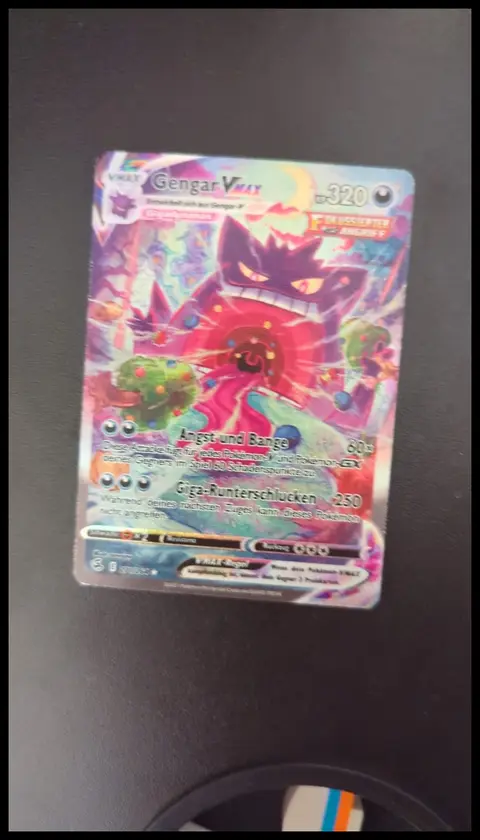
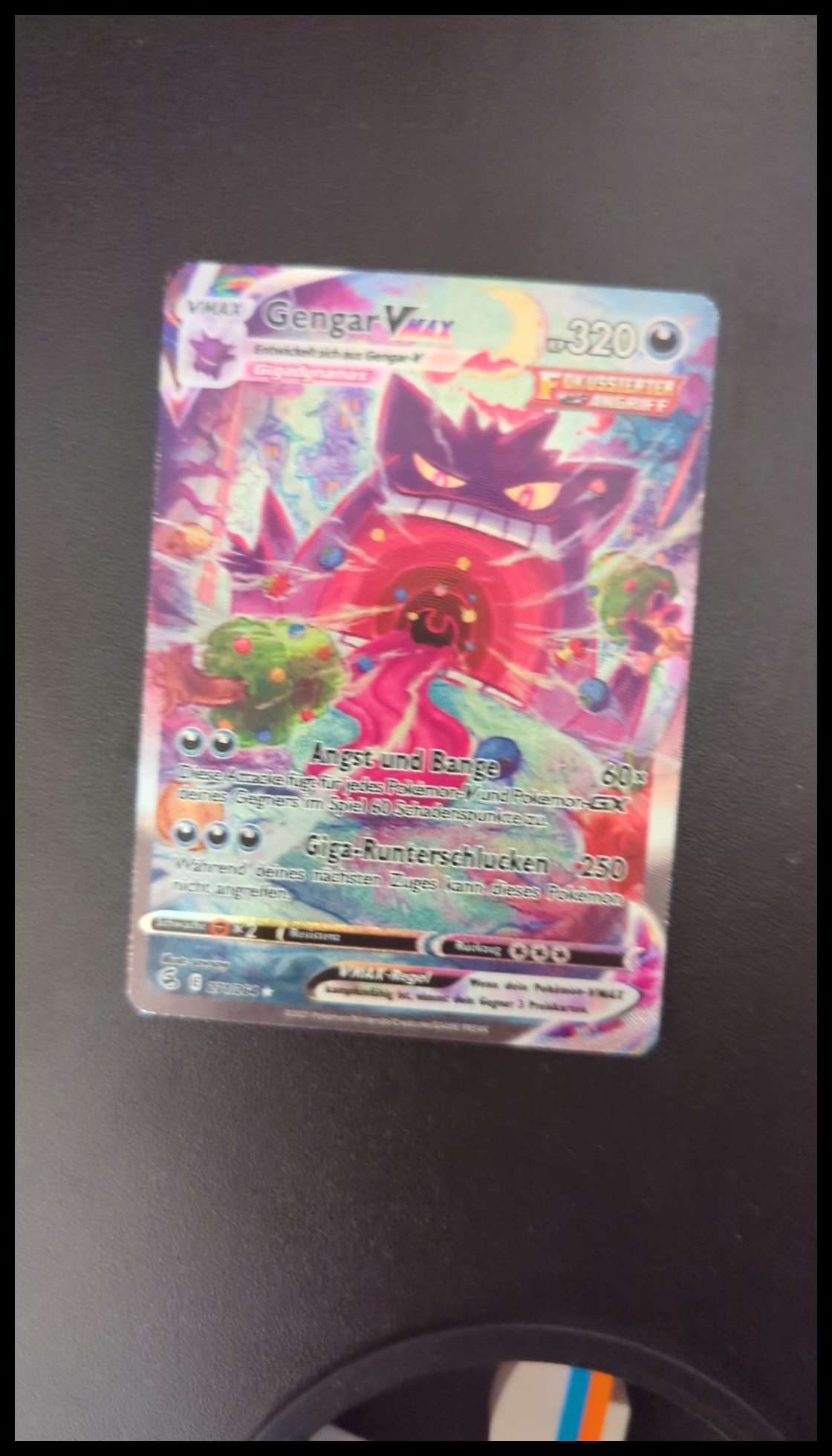
Gengar is a Ghost/Poison-type Pokémon introduced in Generation I. It is the final evolutionary stage of Gastly and Haunter, and is characterized by its shadow-like appearance, mischievous behavior, and association with spirits and darkness. Gengar VMAX depicts Gengar in its Gigantamax form, a Dynamax phenomenon introduced in Pokémon Sword and Shield, where its mouth becomes a massive portal-like opening. The card is especially notable because the alternate-art illustration shows Gengar emerging from a building and consuming food, giving the otherwise menacing Pokémon a humorous personality.
Gengar VMAX was first released in the international Pokémon Trading Card Game expansion Sword & Shield—Fusion Strike, which launched in November 2021. The card is numbered 271/264, placing it in the secret rare section above the set's 264-card numbered set total. German-language copies were released as part of the German localization of the same expansion.
- The card is an Alternate Art Secret Rare and is commonly regarded as one of the most desirable cards in Sword & Shield—Fusion Strike.
- It has VMAX rule-box mechanics and a 320 HP value.
- The alternate-art illustration is widely recognized for its humorous depiction of Gengar eating while emerging from a building.
- The card has recorded hundreds of sales across raw and graded examples, with market prices varying substantially by condition and grading outcome.
- Recent market data places raw near-mint examples broadly around the high hundreds of U.S. dollars, while graded 10 examples have recently sold around $2,100-$2,550.
Collector notes
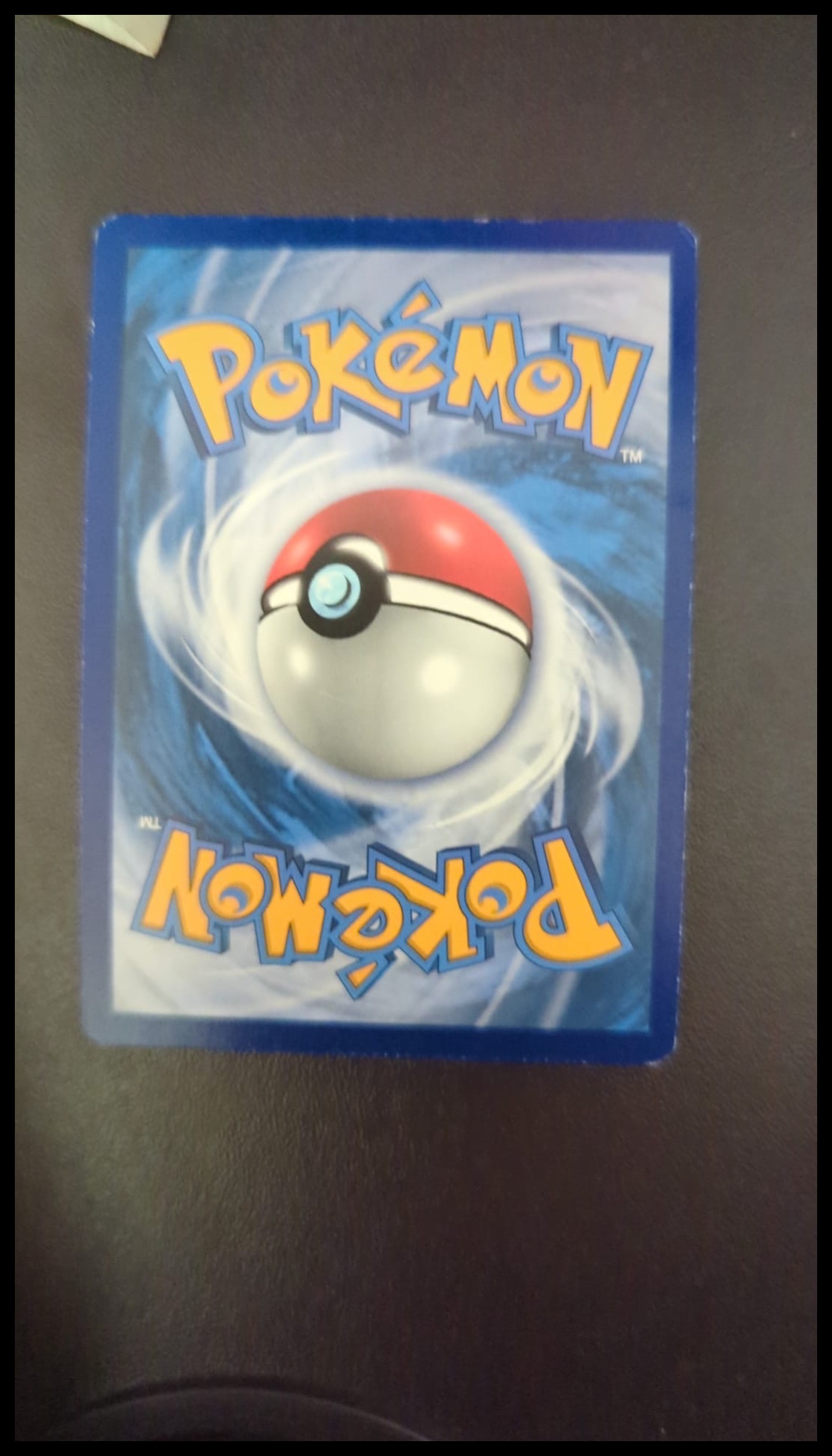
Condition. Inspect the front for edge whitening, corner wear, surface scratches, print lines, dents, roller marks, silvering, and off-centering. On this card, centering and subtle surface damage are particularly important because small flaws can prevent a top grade. Examine the back for whitening along all four edges, especially the lower corners and side borders. Use angled light to identify dents, indentations, scratches, and holofoil scuffing. German copies should have consistent German-language text, clean holofoil, correct 271/264 numbering, and normal Fusion Strike print quality.
Storage. Store the card in a clean soft sleeve followed by a rigid semi-rigid holder or quality toploader. For long-term storage, use an archival box kept upright in a cool, dry, temperature-stable room away from sunlight and humidity. Avoid tight sleeves, loose-fitting holders, PVC materials, stacking heavy objects on top of the card, and frequent handling. Graded copies should remain in their slab and should be protected from heat, moisture, and direct ultraviolet light.
Authenticity. Verify the card dimensions, typography, German wording, 271/264 numbering, texture, holofoil pattern, and trademark and copyright details against a trusted reference scan. Genuine alternate-art secret rares have a distinctive textured surface that should not appear as a flat glossy finish. Common warning signs include incorrect font weight, blurry artwork, unusually dark or light coloring, missing texture, wrong HP or attack text, thin or overly flexible cardstock, and inconsistent back coloration. Compare the card with authenticated copies and use a reputable grading or authentication service for high-value purchases. A legitimate German copy should not be confused with an English, French, Italian, Spanish, or other-language version.