Market outlook
Stable Outlook 7/10
Demand for Stardust Dragon remains strong because it is an iconic ace monster, but prices for non-English variants tend to move more slowly than the most chased English 1st Edition examples. The card’s premium is supported by nostalgia and rarity, while broader market growth is constrained by collector specialization.
Next months. Likely stable to mildly rising, especially for clean graded copies and well-centered Italian prints.
Long term. Likely gradual appreciation for high-grade examples if collector interest in Ghost Rare era cards continues, with the strongest gains concentrated in pristine or gem-mint copies.
History
Stardust Dragon is a signature Synchro Monster from Yu-Gi-Oh! 5D's, associated with the protagonist Yusei Fudo. In the anime and manga era, Stardust Dragon became one of the defining monsters of the Synchro era and is widely recognized as Yusei's ace card, symbolizing protection, sacrifice, and resilience.
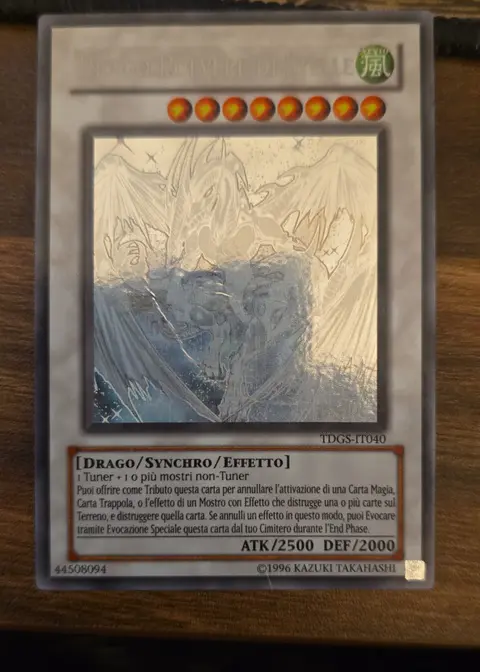
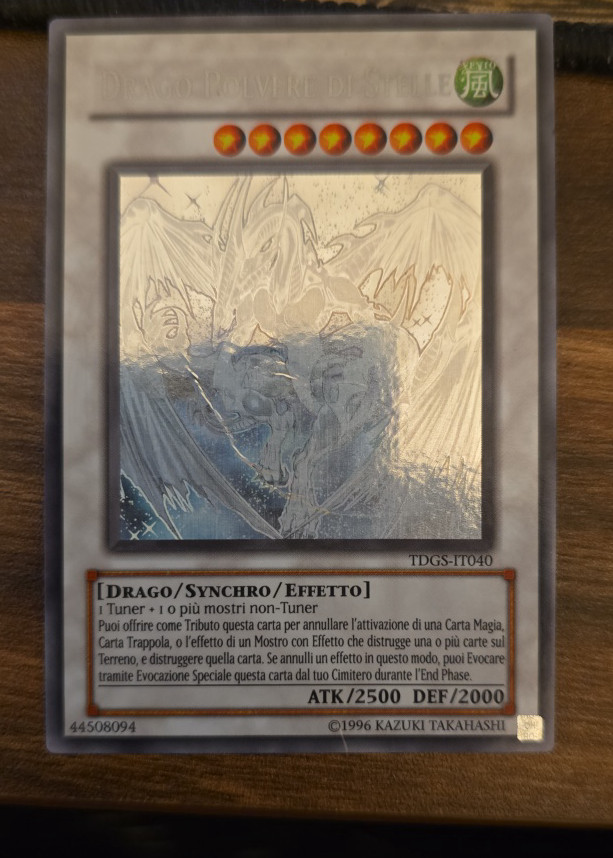
First released in The Duelist Genesis in 2008 as TDGS-EN040 in the English TCG Ghost Rare printing; this card also appears in other language printings, including the Italian version designated IT040.
- Ghost Rare is one of the most sought-after visual treatments in Yu-Gi-Oh!, with the artwork appearing engraved and highly reflective.
- TCGplayer lists the card as WIND / Dragon / Synchro / Effect with 2500 ATK and 2000 DEF.
- graded Cards reported multiple certified examples across printings, including 29 Ghost Rare copies from The Duelist Genesis and 12 Ghost Rare 1st Edition examples as of May 2024.
Rarity and print run
- Tier
- Secret Rare
- Print run
- Very High
- First printed in
- The Duelist Genesis
- Demand
- High
- Supply
- Low
- Ghost Rare treatment is visually premium and difficult to keep in top condition.
- High collector demand comes from Stardust Dragon's iconic status in Yu-Gi-Oh! 5D's.
- Italian-language premium collectibles are typically a smaller submarket than English copies.
- Top-graded examples are limited by foil scratching and centering issues.
Collector notes
Condition. Check for edge whitening, corner wear, surface scratching on the Ghost Rare foil, centering, and print lines or roller marks common on reflective Yu-Gi-Oh! cards. Ghost Rares are especially prone to foil scratching and small nicks that are easy to miss under normal lighting.
Storage. Use a penny sleeve plus a rigid top loader or semi-rigid holder, keep the card away from humidity and direct sunlight, and avoid friction against other cards because Ghost Rare foil can show wear quickly. For long-term preservation, store vertically in a cool, dry environment and handle only by the edges.
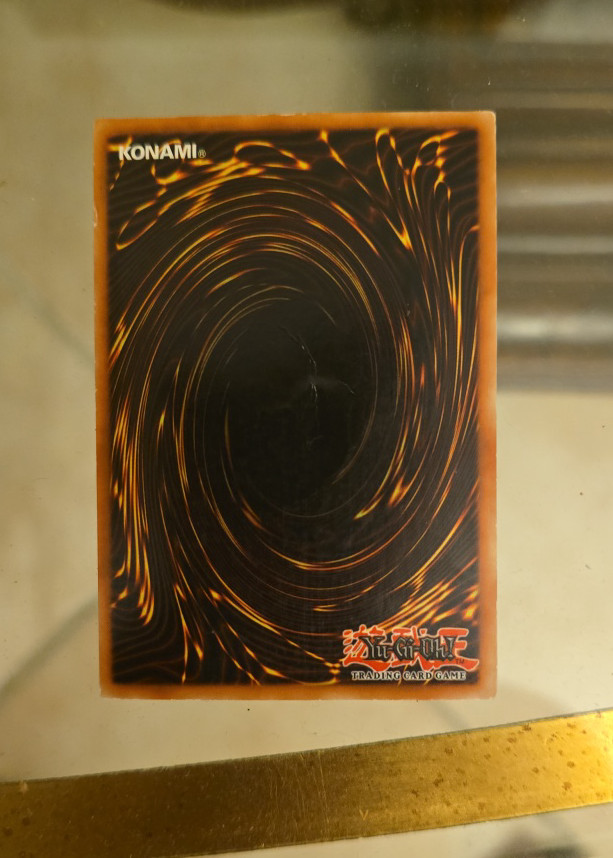
Authenticity. Authentic copies should match the Italian IT040 numbering and Ghost Rare surface pattern, with crisp text, correct font weight, and proper Konami-era print quality. Fakes often have blurry text, incorrect holographic texture, off-color borders, or overly flat foil effects; comparing the card to verified scans and checking for exact set code placement are the most practical authentication steps.
Sources: tcgplayer.com, cgccards.com, pricecharting.com, youtube.com, trollandtoad.com