Market outlook
Rising Outlook 7/10
Recent market data shows meaningful movement in certain grades, especially mid-to-high grade copies, with strong liquidity and continued interest in Maris as a Yankees icon and home run record holder. Vintage demand remains healthy, and graded/registry-driven collectors keep pressure on clean, well-centered examples.
Next months. Expect stable to slightly higher prices, with the best-centered and highest-grade copies continuing to outperform lower-grade examples.
Long term. Over 1-3 years, the card should continue a slow appreciation trend, especially in graded 8 and above, though the largest gains are likely to come from premium condition examples rather than raw or lower-grade copies.
History
Roger Maris (1934–1985) was a star Major League Baseball outfielder best known for breaking Babe Ruth's single-season home run record in 1961 with 61 home runs, a milestone that made him one of the most famous players of the live-ball era. He played for the Cleveland Indians, Kansas City Athletics, New York Yankees, and St. Louis Cardinals, winning two AL MVP awards and earning a lasting place in baseball history despite not being elected to the Hall of Fame.
The card was first released in the 1959 Topps Baseball set, distributed in wax packs and factory products by Topps during the 1959 baseball season in the United States.
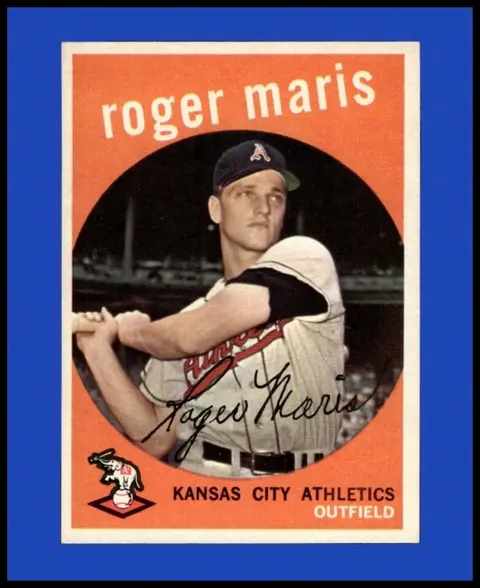
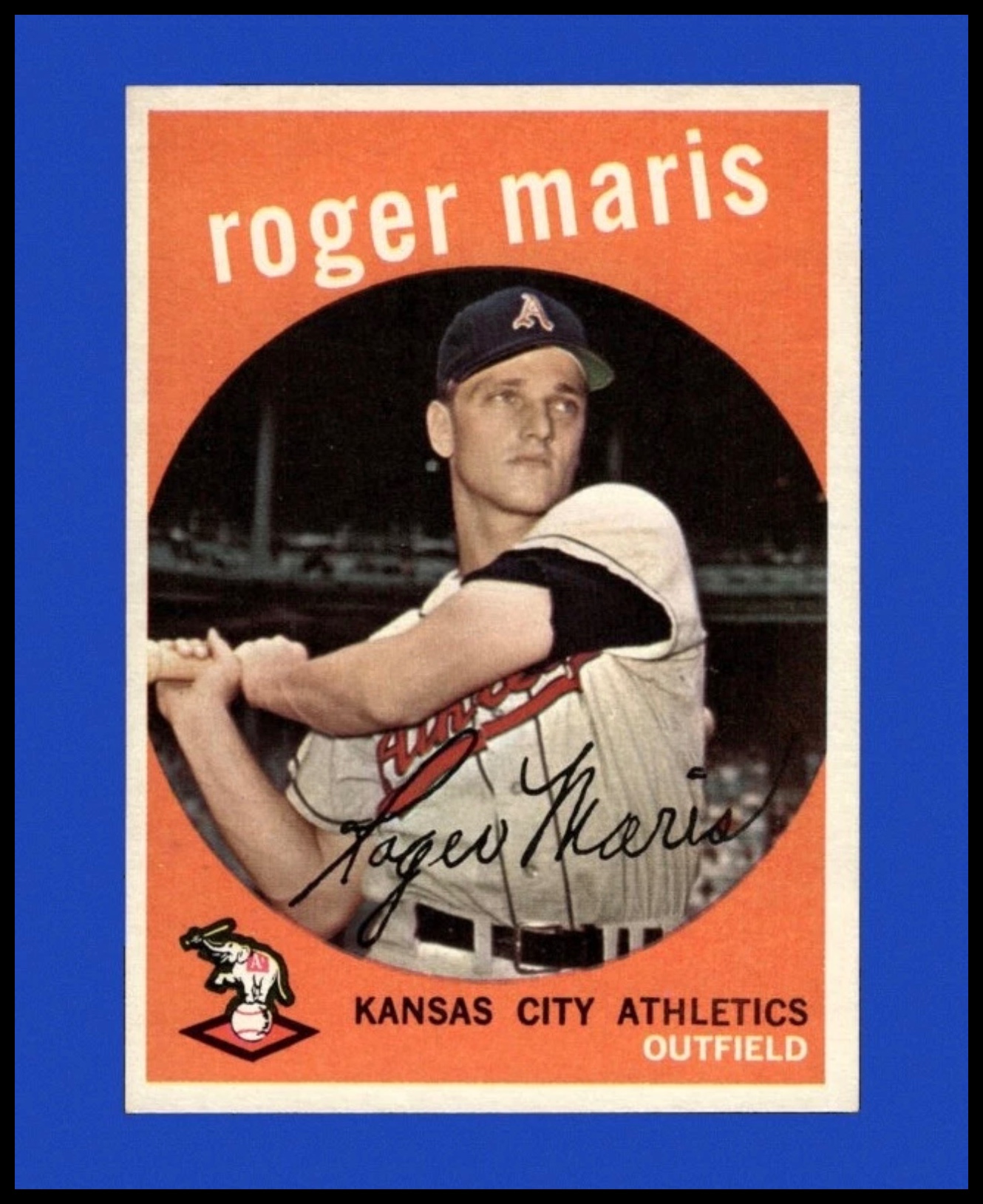
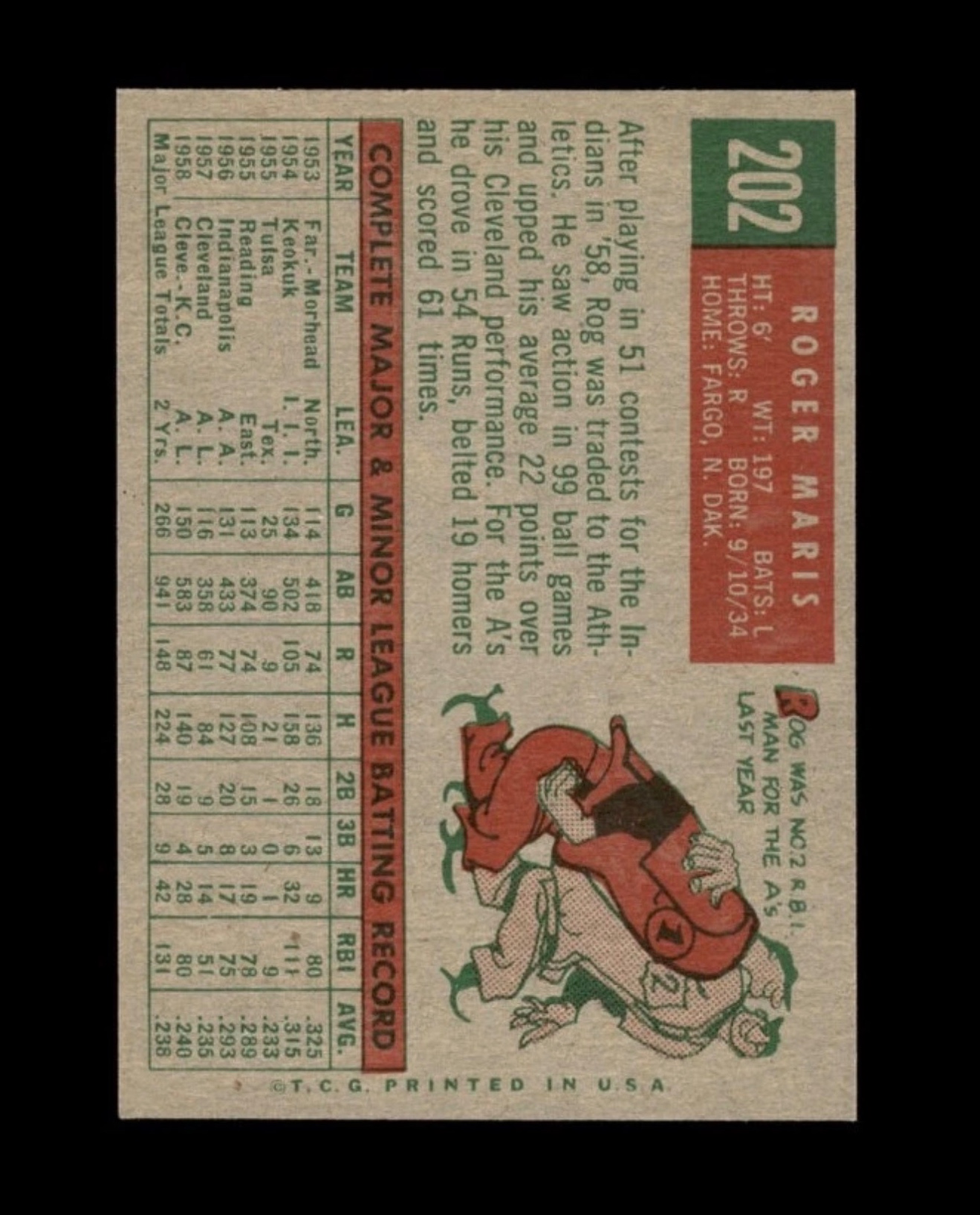
- Card #202 is Roger Maris' standard 1959 Topps base card, widely collected as one of his key early-career cards.
- 1959 Topps is known for its colorful, multi-player horizontal design and for including several Hall of Fame and star rookie-era cards.
- Maris cards from 1959 are significantly more affordable than his 1958 Topps rookie card but remain highly liquid because of his Yankees popularity and record-setting 1961 season.
Rarity and print run
- Tier
- Common
- Print run
- Very High
- First printed in
- 1959 Topps Baseball
- Demand
- High
- Supply
- High
- It was printed in a very large flagship Topps production run.
- Availability is broad in mid-grade condition because many examples survived in collectors' hands.
- High-grade examples are much scarcer than average copies due to poor centering and corner wear, even though the card itself is not intrinsically rare.
Collector notes
Condition. This card is sensitive to centering, corner wear, edge chipping, surface gloss loss, print defects, and yellowing. Because the 1959 Topps design has broad borders, off-centering is common and heavily impacts grade. Look closely for soft corners, edge dings, surface scratches, and toning. In higher grades, clean surfaces and strong eye appeal are especially important.
Storage. Store in a penny sleeve and semi-rigid holder or top loader, ideally inside a card saver for submissions. Keep the card away from humidity, sunlight, and temperature swings to prevent warping and paper toning. For long-term preservation, use archival-quality sleeves and boxes, and avoid handling the surface with bare fingers.
Authenticity. Authentic 1959 Topps cards should show period-correct paper stock, printing texture, and aging consistent with age. Reprints often look too sharp, too glossy, or have modern printing dots and uniform color saturation. Check the back for correct Topps stock and aging, and compare font, registration, and border coloration to verified examples. For higher-value copies, third-party grading from graded, graded, or graded is recommended.
Sources: sportscardinvestor.com, sportscardspro.com, steinersports.com, oldsportscards.com, steelcitycollectibles.com