Market outlook
Stable Outlook 7/10
The card benefits from long-standing Hall of Fame demand and a large collector base, but supply is not limited enough to drive dramatic short-term price spikes except in top grades. Price movement is most likely to track general vintage baseball market strength and condition scarcity.
Next months. Expect prices to remain steady with modest fluctuations, especially for raw and mid-grade copies. Exceptional eye-appeal or high-grade certified examples may continue to command premiums.
Long term. Over 1-3 years, the card should hold value well and likely appreciate gradually, with the strongest gains concentrated in graded 8 and graded 9 copies as condition scarcity becomes more important to collectors.
History
Brooks Calbert Robinson Jr. (1937–2023), nicknamed the 'Human Vacuum Cleaner,' was one of baseball’s all-time great third basemen and a Hall of Fame icon of the Baltimore Orioles. Signed by Baltimore at 17, he rose through the Orioles system and became the face of elite defensive play at third base, winning 16 Gold Gloves and helping lead Baltimore to multiple pennants and World Series titles. His significance is rooted in both defensive excellence and long-term consistency, making him one of the most respected players of the era.
1960 Topps Baseball cards were first released in 1960 in the United States by Topps Chewing Gum, Inc., as part of the flagship 1960 Topps baseball set distributed through hobby shops, packs, and retail outlets nationwide.
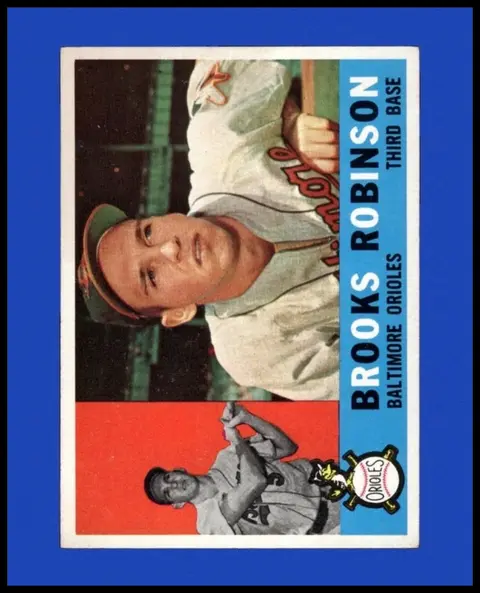
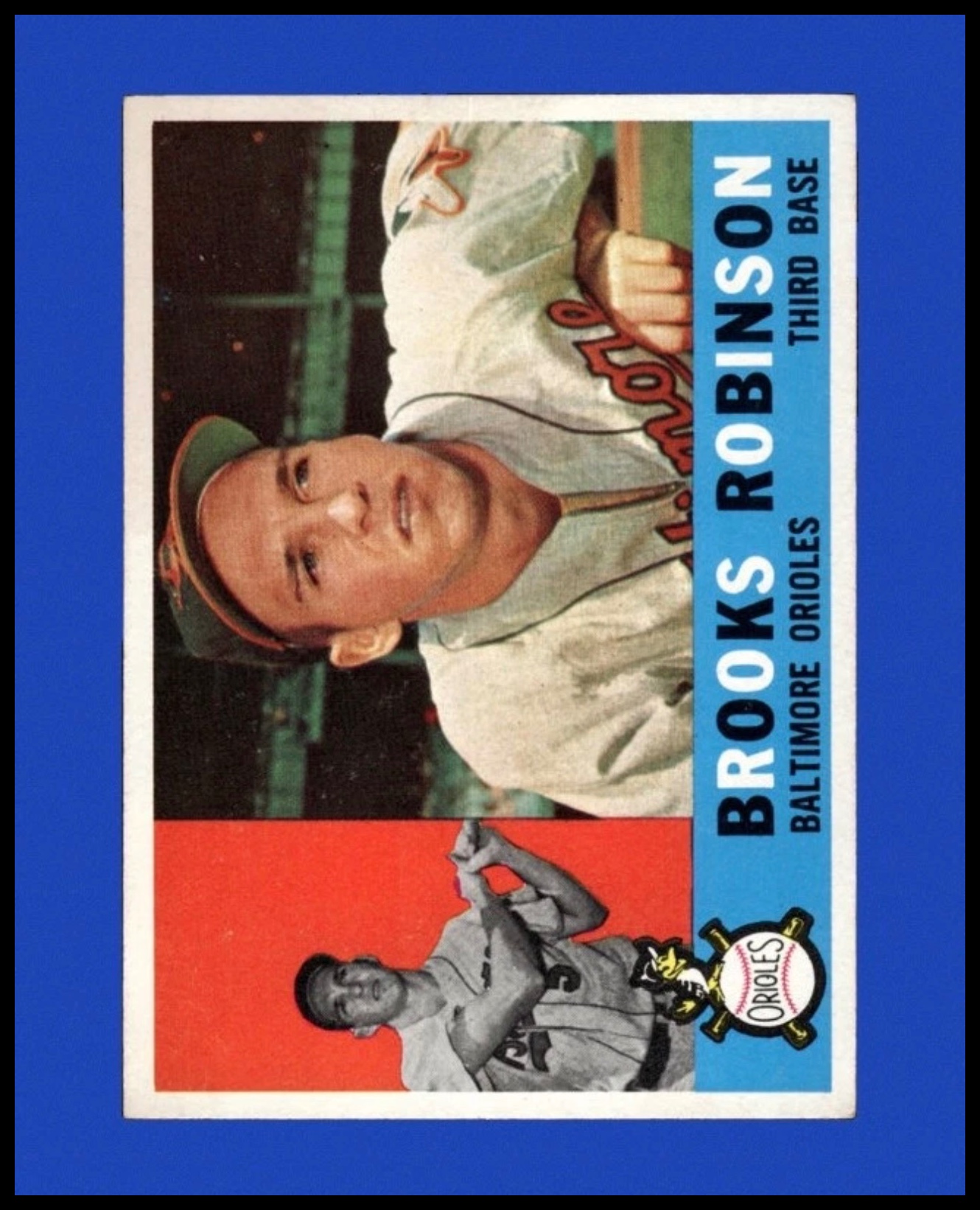
- This is Brooks Robinson’s widely collected rookie-era card in the 1960 Topps flagship set, and it is one of his key early-career cards.
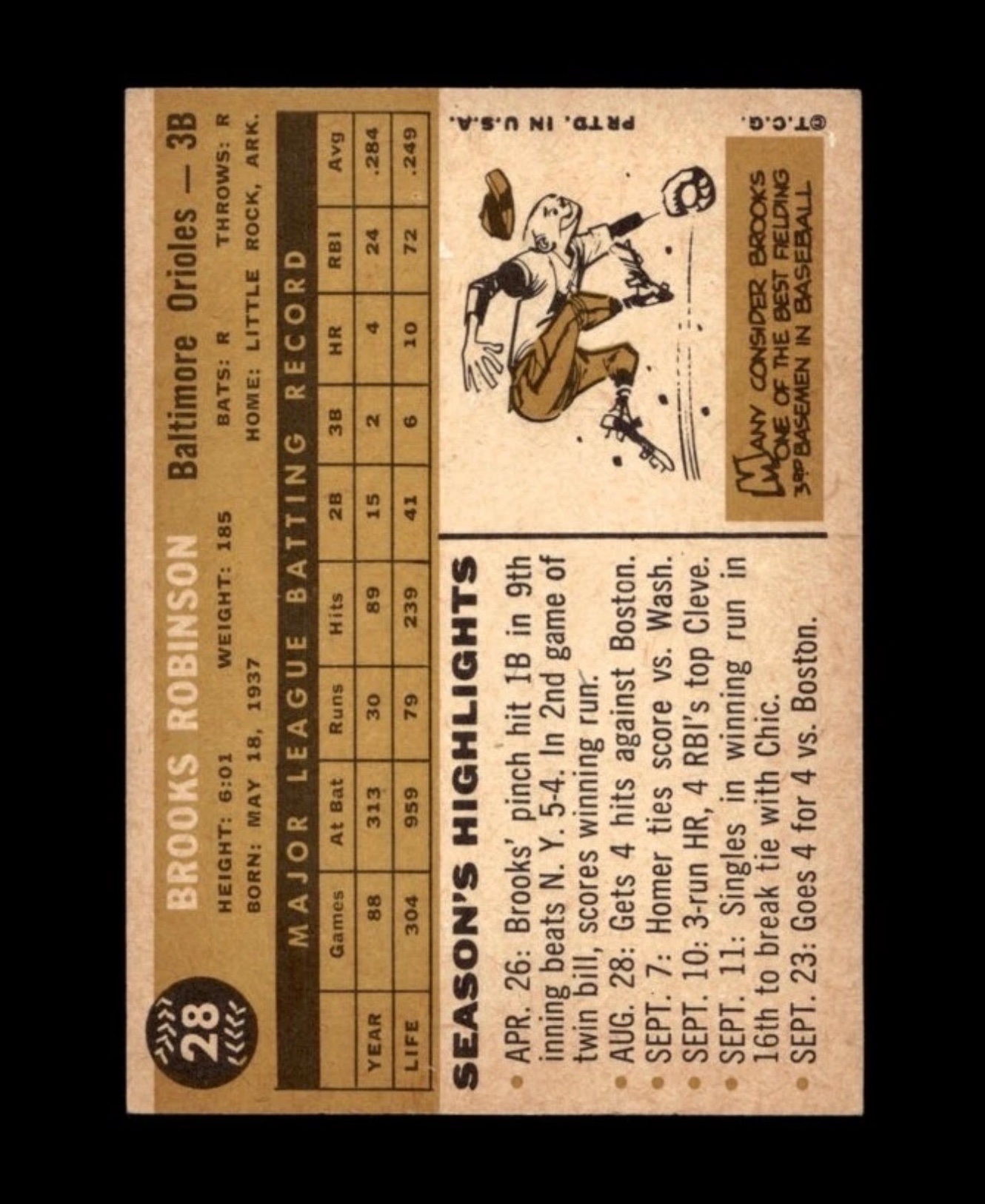
- The card is card #28 in the 1960 Topps baseball set, a popular issue known for large black-bordered fronts that are prone to corner wear.
- Brooks Robinson is regarded as one of the greatest defensive third basemen in baseball history and was elected to the Hall of Fame in 1983.
Rarity and print run
- Tier
- Common
- Print run
- Very High
- First printed in
- 1960 Topps Baseball
- Demand
- High
- Supply
- Medium
- Original pack distribution was large, so the card is not rare in absolute terms.
- High-grade copies are meaningfully harder to find because the 1960 Topps black borders chip and wear easily.
- Collector demand for Brooks Robinson and 1960 Topps keeps top-condition examples relatively scarce in the market.
Collector notes
Condition. Check the notoriously fragile black borders for chipping, corner whitening, and edge wear. Centering is important, and surface scratches, print snow, wax staining, and corner dings are common. Because the card is from a heavily collected Topps issue, high-grade examples are difficult to find.
Storage. Store in a penny sleeve and rigid holder or semi-rigid card saver. Keep away from humidity, direct sunlight, and temperature swings. For higher-grade copies, use an archival, non-PVC holder and avoid frequent handling because black borders show wear quickly.
Authenticity. Authentic 1960 Topps cards should have correct period paper stock, standard Topps printing characteristics, and aging consistent with a 1960 issue. Reprints may have overly bright stock, blurry registration, modern gloss, or incorrect border tone. For valuable graded copies, graded, graded, or Beckett certification is recommended to confirm authenticity and surface integrity.
Sources: psacard.com, sportscardinvestor.com, sportscardspro.com, deanscards.com, steinersports.com