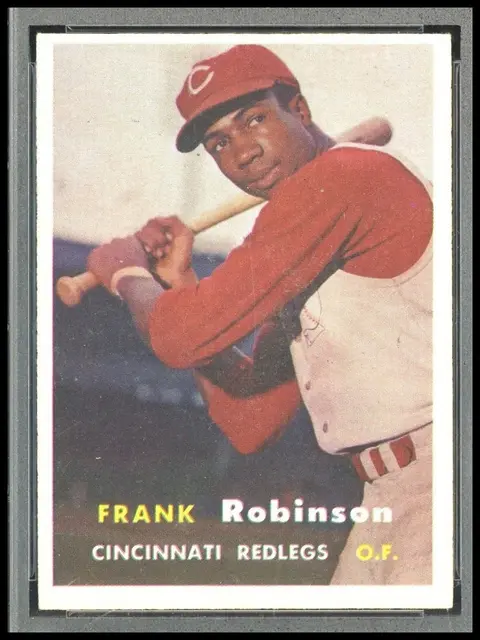
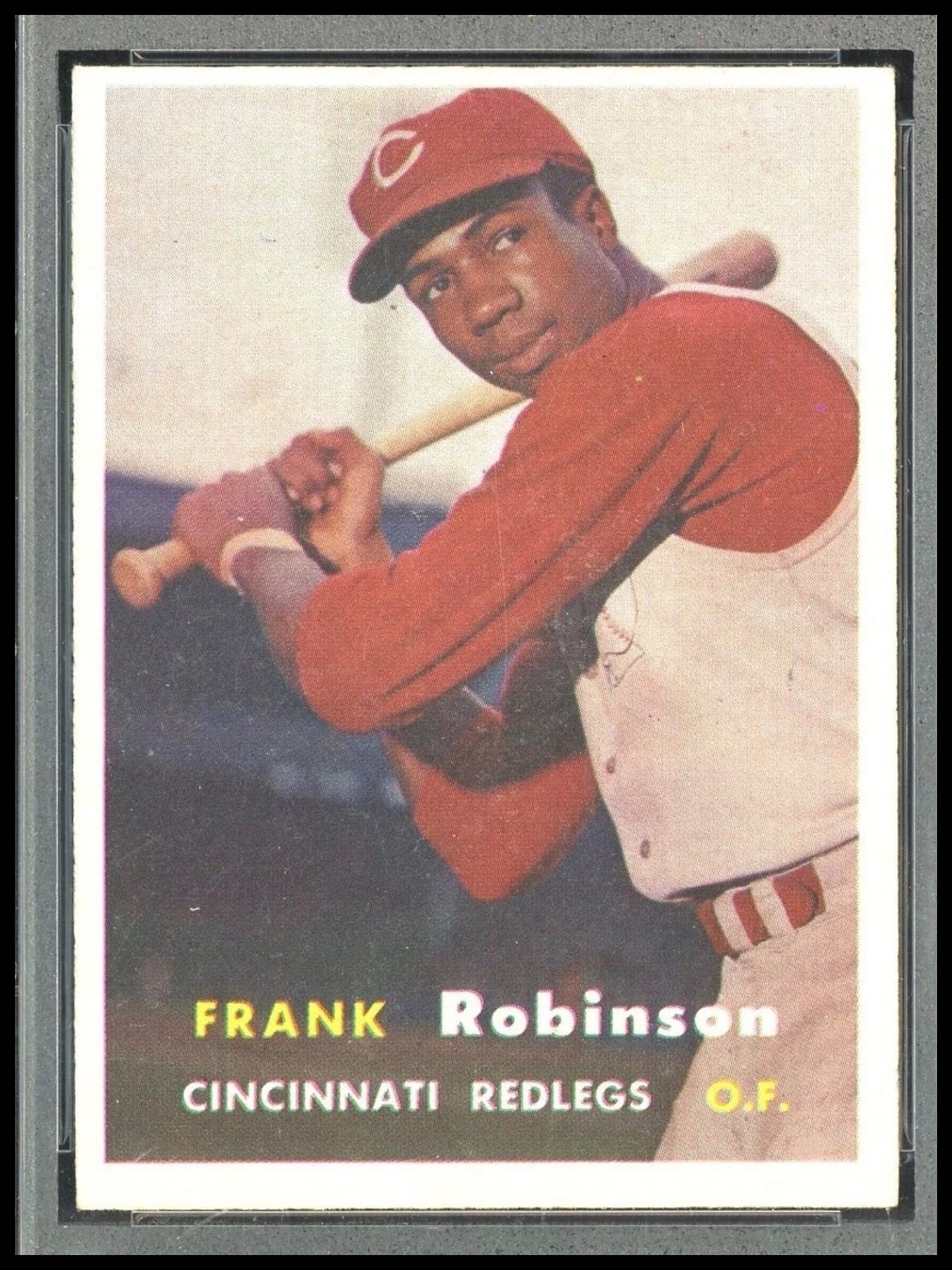
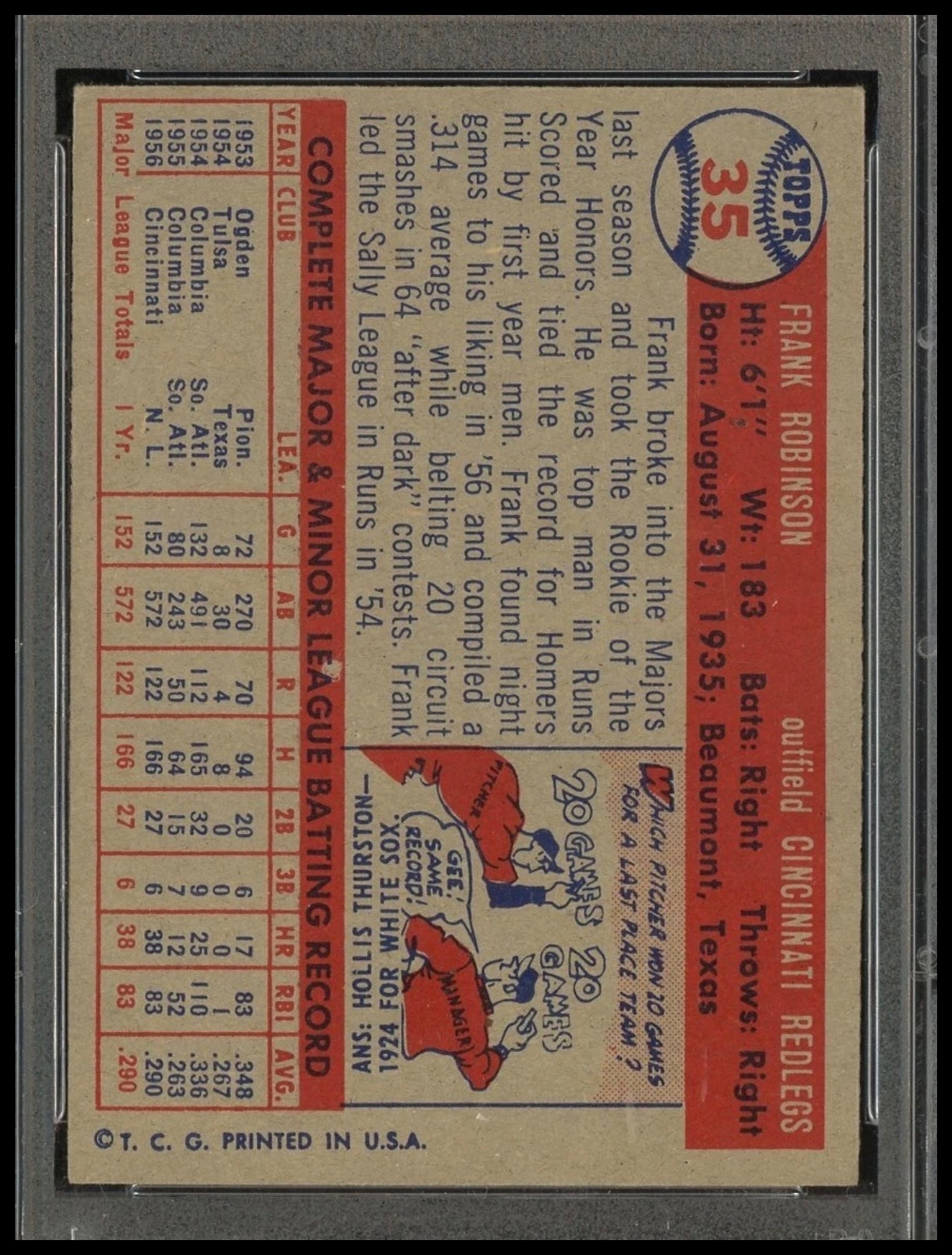
Market outlook
Rising Outlook 8/10
The card benefits from steady Hall of Fame rookie demand, strong nostalgia for the 1957 Topps set, and limited supply of high-end examples. While the overall vintage market can fluctuate, iconic rookies tend to hold value well and often appreciate over time.
Next months. Likely stable to modestly rising, with best-condition and high-grade copies continuing to outperform lower-grade examples.
Long term. Expected to appreciate gradually over 1-3 years, especially in graded 7+ and strong eye-appeal examples, with premium growth concentrated in the best-centered and highest-grade copies.
History
Frank Robinson (1935-2019) was one of baseball's greatest all-around players and a landmark figure in the sport's history. Born in Beaumont, Texas, and raised in Oakland, California, he broke into the majors with the Cincinnati Reds in 1956 and quickly became a superstar. Robinson was the 1956 National League Rookie of the Year, the 1961 NL MVP, the 1966 American League MVP, and the first player to win MVP honors in both leagues. He later became the first Black manager in Major League Baseball when he managed the Cleveland Indians in 1975. His 1957 Topps card is especially significant because it is generally recognized as his rookie card and captures the early career of a Hall of Fame talent before he became one of the era's defining sluggers.
First released in 1957 as part of Topps Baseball, distributed through wax packs and hobby retail channels in the United States during the 1957 baseball card season. The set was produced by Topps Chewing Gum, Inc. and issued in multiple series throughout the year.
- Widely regarded as Frank Robinson's rookie card and one of the key rookie cards in the 1957 Topps set.
- The 1957 Topps design is famous for its clean full-color player portraits on the front and statistical backs, making it a collector favorite.
- Card #35 is a popular Hall of Fame rookie, with strong long-term demand across all graded conditions.
Rarity and print run
- Tier
- Common
- Print run
- High
- First printed in
- 1957 Topps Baseball
- Demand
- Very High
- Supply
- High
- The card is from a mass-produced 1957 Topps issue, so it is not intrinsically rare.
- High-grade copies are much scarcer than raw copies because centering, corners, and surface wear limit survivorship in top condition.
- Demand is elevated because it is a key rookie of a Hall of Famer and inner-circle superstar.
Collector notes
Condition. Check centering carefully, especially left-to-right centering which is a major value driver for 1950s Topps. Common flaws include corner wear, edge chipping, surface scratches, print snow, wax staining, and back wear from album storage. Focus on the front image clarity, boldness of color, and whether the back has erasures, pencil marks, or rough paper loss. Because the card is a rookie and heavily collected, even small condition differences can create large price gaps.
Storage. Store in a penny sleeve and semi-rigid holder or top loader for raw copies, ideally inside a team bag to reduce movement and moisture exposure. For long-term preservation, keep in a cool, dry, dark environment with stable humidity. High-grade or valuable copies should be slabbed by graded, graded, or another major grading service. Avoid PVC holders, rubber bands, and direct handling without clean dry hands or gloves.
Authenticity. Authentic 1957 Topps cards should show the period-correct cardboard stock, printing pattern, and natural aging consistent with age. Reprints may have sharper modern print dots, incorrect gloss, unusually bright stock, or artificially aged surfaces. Compare the font, border color, and back statistics layout to known authentic examples. For high-value raw copies, third-party grading is strongly recommended.
Sources: mlbshop.com, bbcemporium.com, youtube.com, sportscardinvestor.com, cardladder.com