Market outlook
Stable Outlook 8/10
The card maintains consistent pricing across grades with historical precedent. Recent sales data shows modest fluctuations typical of mature vintage cards rather than significant appreciation or depreciation.
Next months. Expect stable pricing with modest fluctuations. graded 8 copies likely to remain in the $500-$800 range. Any significant price movement would require shifts in broader vintage card market conditions.
Long term. Positive long-term outlook with potential for gradual appreciation. As the 1970s baseball card market continues to mature and condition-sensitive collectors drive demand for high-grades, scarce high-grade examples may appreciate. Lower grades remain stable storage of value.
History
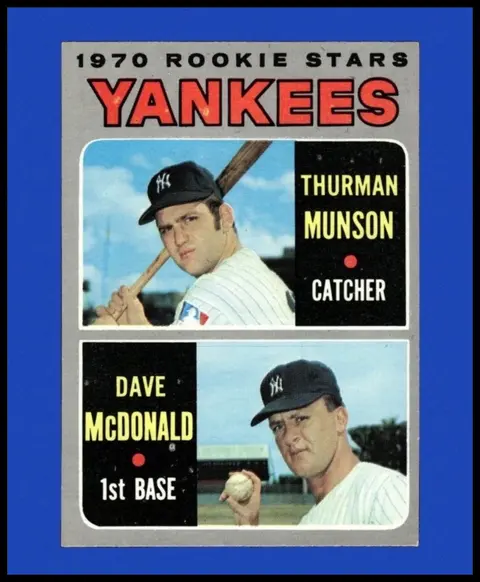
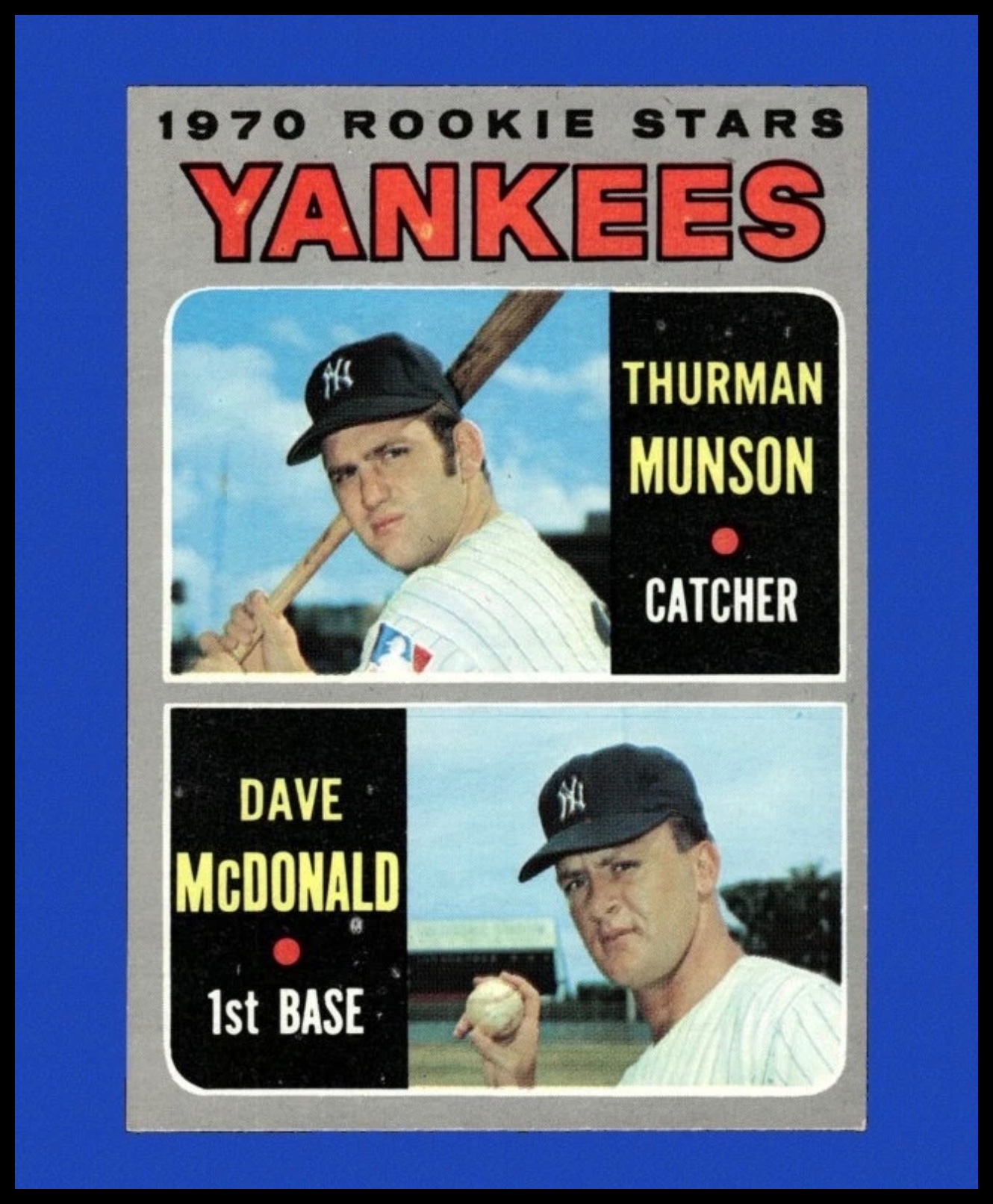
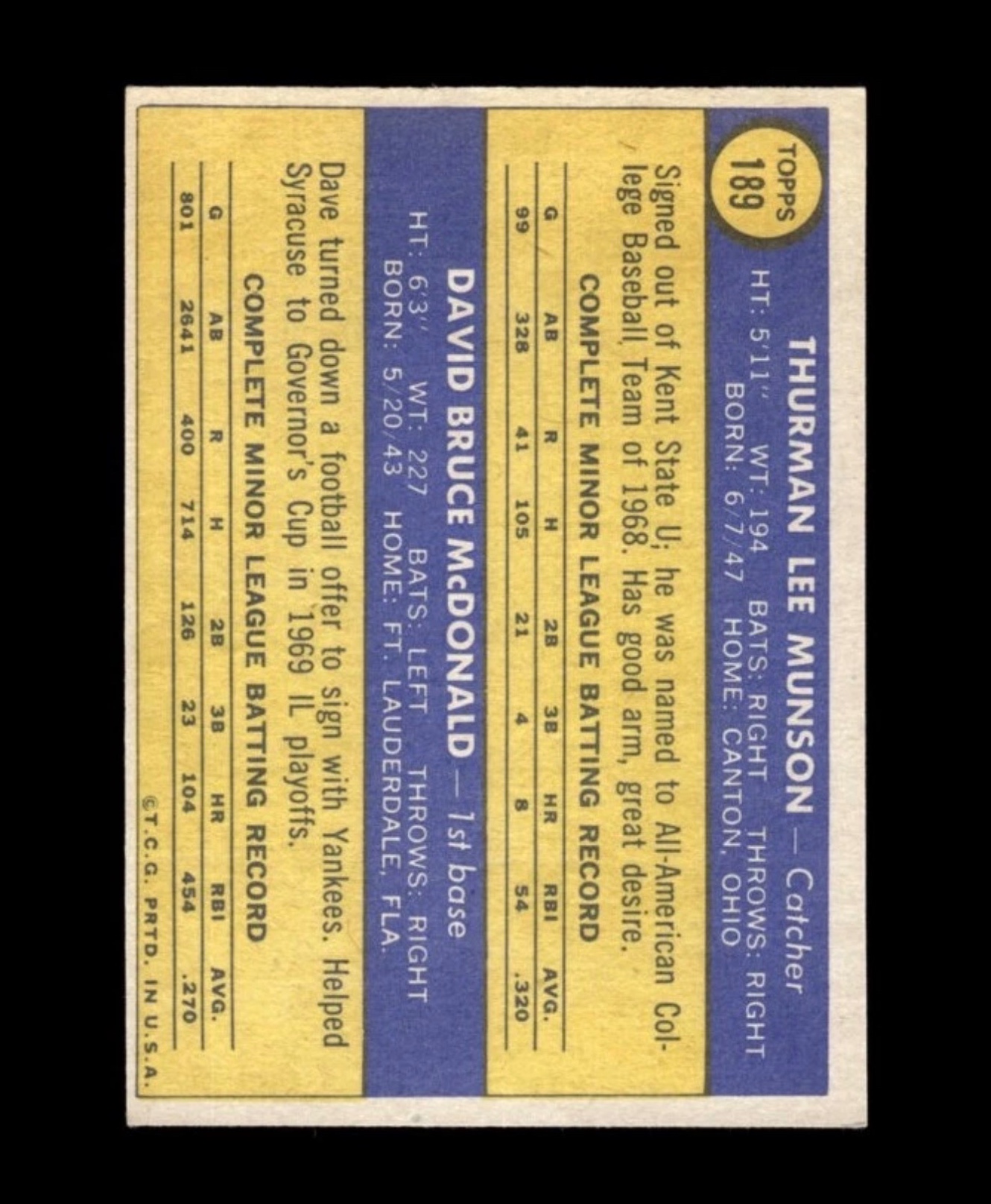
Thurman Munson was a Hall of Fame catcher for the New York Yankees who became one of baseball's most iconic players of the 1970s. Dave McDonald was a lesser-known player who shared this rookie card. Munson went on to win the AL MVP award in 1976 and was a 7-time All-Star before his tragic death in a plane crash in 1979.
1970 Topps baseball card set, released in 1970
- This is Thurman Munson's official rookie card, making it highly significant in baseball card collecting
- The card features the 'Rookie Stars' designation, a Topps tradition for highlighting promising newcomers
- Munson became a Yankees legend and captain, winning the 1976 AL MVP award
- The card's value has been significantly influenced by Munson's Hall of Fame career and tragic death
Rarity and print run
- Tier
- Uncommon
- Print run
- High
- First printed in
- 1970 Topps
- Demand
- Very High
- Supply
- Medium
- While originally high print run, high-grade examples are scarce
- 1970 Topps cards frequently show centering and wear issues, making gem-quality copies rare
- graded population data shows 875 graded NM-MT 8s but only 144 higher
- Only 4 known graded 10 examples exist
Collector notes
Condition. Key areas to examine include: corners (prone to wear and rounding), edges (common flaw area), centering (typical issue with 1970 Topps), surface wear and gloss retention, and print quality. 1970 Topps cards commonly show wear on the borders and are rarely found in high grades.
Storage. Store in acid-free sleeves and holders away from direct sunlight, humidity, and temperature fluctuations. Use top-loaders for ungraded copies and store graded/graded slabs in protective cases. Keep in a climate-controlled environment (65-70°F, 40-50% humidity) to prevent degradation.
Authenticity. Examine printing quality, color vibrancy, and card stock thickness typical of 1970 Topps production. Verify the card stock feel and weight. Check for reprints which typically show inferior print quality and different paper composition. graded and graded authentication provides definitive verification.
Sources: sportscardspro.com, psacard.com, cardladder.com, sportscardinvestor.com, deanscards.com