Market outlook
Stable Outlook 9/10
Recent graded 8 dip of 4.7% but high-grade averages remain strong at $110k for graded 9, supported by Mays' legendary status.[1][5]
Next months. Stable with potential graded 8 rebound to $20k+.
Long term. Rising due to scarcity and Mays' Hall of Fame legacy.
History
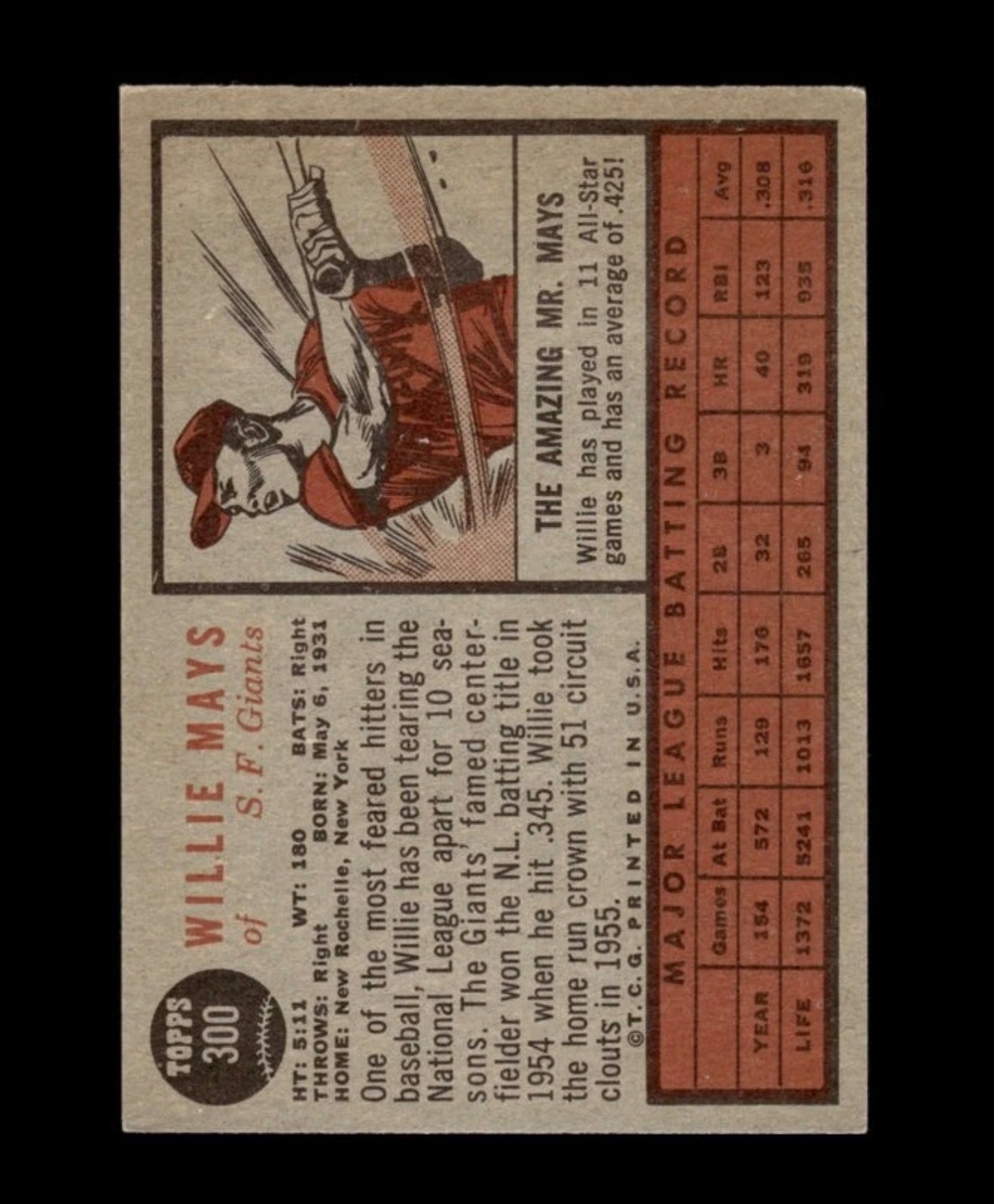
Willie Howard Mays (May 6, 1931-) is arguably the greatest centerfielder in Major League Baseball history, retiring with 3,283 hits, 2,062 runs scored, 1,903 RBI, 338 stolen bases, 660 home runs, and a .302 batting average. A 24-time All-Star, 12-time Gold Glove winner, 1951 NL Rookie of the Year, two-time NL MVP (1954, 1965), and 1954 World Series champion with the New York Giants, Mays played most of his 22-year career with the Giants (1951-1952, 1954-1972) and is iconic for 'The Catch' in the 1954 World Series. Elected to the Hall of Fame in 1979.[1]
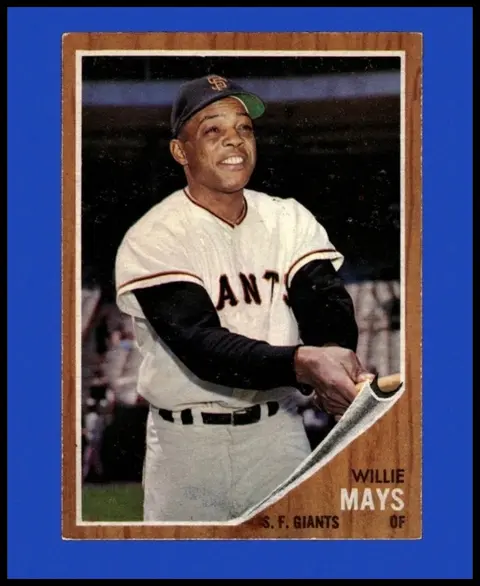
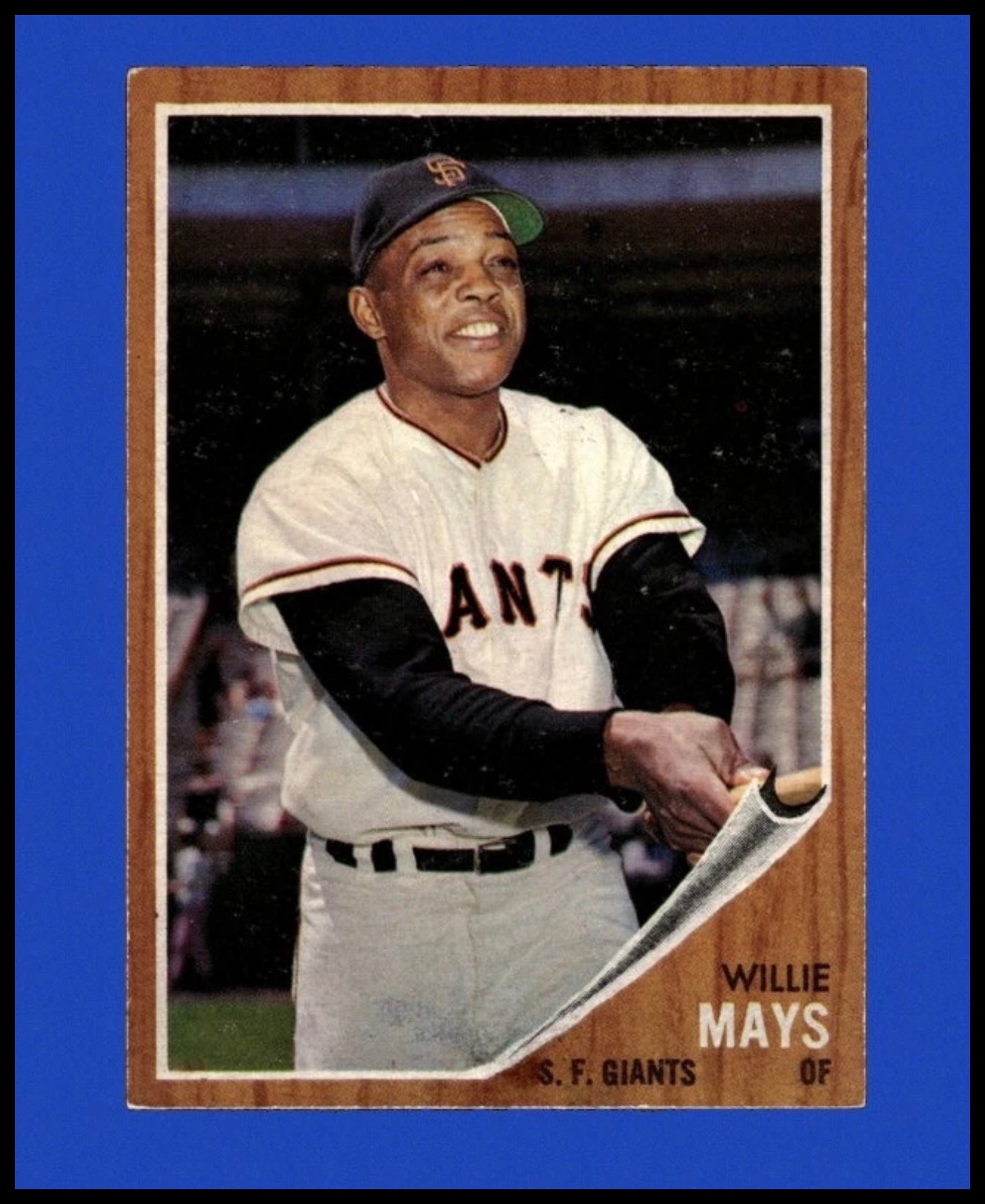
First released in 1962 as part of the Topps baseball card series in the United States.[1][2]
- One of five players with eight straight 100-RBI seasons.
- 660 home runs ranked third all-time behind Hank Aaron and Babe Ruth at retirement.
- Iconic over-the-shoulder catch of Vic Wertz's drive in 1954 World Series Game 1.[1]
Rarity and print run
- Tier
- Rare
- Print run
- High
- First printed in
- 1962 Topps Baseball[1][2]
- Demand
- High
- Supply
- Low
- High print run but poor survival rate due to black-bordered design prone to chipping and centering issues.
- Only 9 graded 9s and 1 graded 10 in population, making gem mint copies ultra scarce.[1]
Collector notes
Condition. Check for centering issues common in 1962 Topps cards, print defects, edge wear, corner damage, and surface scratches; high-grade examples are rare with only 9 graded 9s and 1 graded 10 known.[1]
Storage. Store in protective sleeves and top-loaders, maintain in low-humidity environment away from light, use card savers for handling.
Authenticity. Verify Topps 1962 design elements like black borders and player pose; check for correct card stock thickness and print quality; professional grading by graded or graded recommended; graded population reports show low high-grade supply.[1]
Sources: psacard.com, deanscards.com, allstarcardsinc.com, sportscardspro.com, sportscardinvestor.com