Market outlook
Stable Outlook 7/10
Japanese Secret Rares from the Scarlet & Violet era have a steady but not explosive market due to higher supply. Magikarp's enduring popularity provides a stable floor, but the card is not a 'chase' card like Pikachu or Gengar[1][5].
Next months. Stable prices between $150-$250 for graded 9-10; minimal fluctuation expected
Long term. Gradual appreciation to $300-$450 over 1-3 years if Magikarp remains a top-tier nostalgic character and graded 10 copies remain scarce due to card sensitivity
History
Magikarp is one of the most iconic Pokémon in the franchise, known as the 'weak' fish Pokémon that evolves into the powerful Gyarados. It symbolizes perseverance and the potential for greatness despite initial weakness, a theme central to the Pokémon series[N/A].
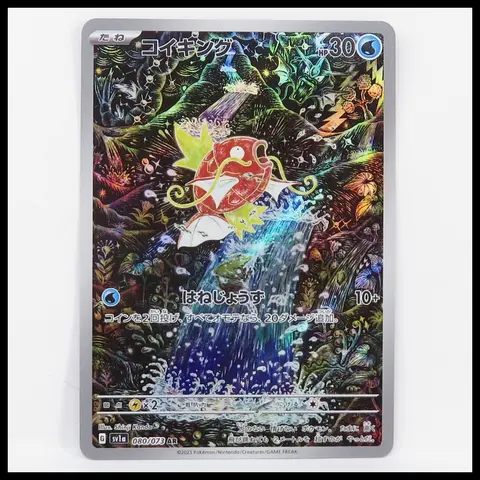
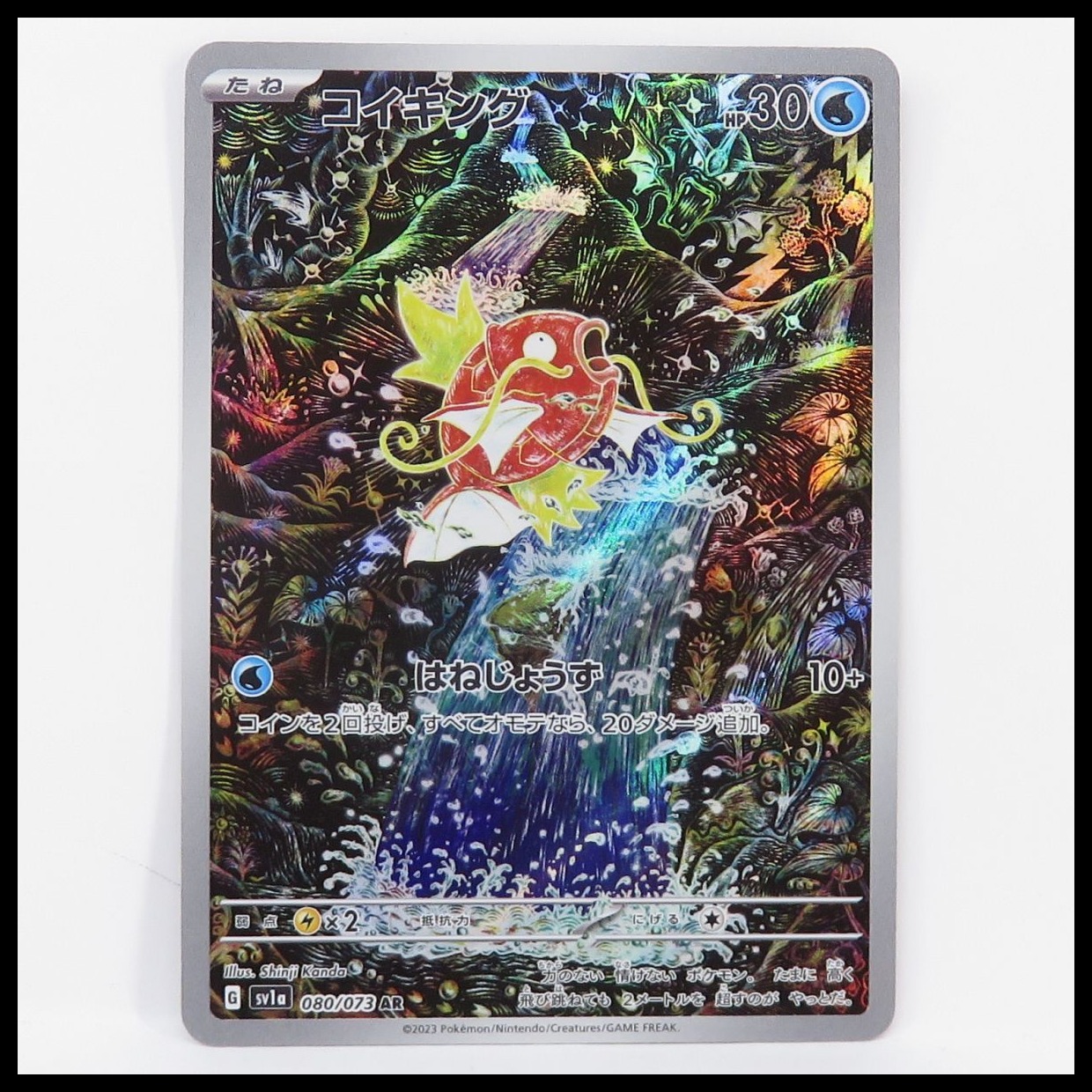
- The card number 080/073 indicates it is a Secret Rare, exceeding the main set size of 73 cards[6].
- Magikarp #080 is classified as an Art Rare (AR), a Japanese rarity tier featuring full-art illustrations with no attack text[1].
- This card is highly sought by collectors for its pristine condition potential, with a graded 10 copy selling for $417.50[5].
Rarity and print run
- Tier
- Secret Rare
- Print run
- Low
- First printed in
- Triple Beat (SV1a)
- Demand
- Medium
- Supply
- Medium
- Card number 080/073 exceeds the set's 73-card limit, making it a Secret Rare[6].
- Art Rare (AR) rarity features full-art artwork with no attacks, a distinct and collectible tier in Japanese sets[1].
- Produced in the Japanese market, which typically has higher print volumes than Western markets[10].
Collector notes
Condition. Check for corner dings, edge whitening, and surface scratches common on full-art cards. The glossy finish of Art Rares makes them prone to visible scratches if not handled carefully. Ensure the 'AR' stamp is clear and not faded[5].
Storage. Store in a rigid top loader immediately. Use a penny sleeve inside the top loader to prevent edge wear. For long-term value, submit for graded grading, as the market heavily favors graded 10 copies[5][7].
Authenticity. Authentic Japanese Art Rares have a specific holographic pattern and the 'AR' stamp in the bottom right. Fakes often have duller colors, incorrect font for the card number, or lack the subtle texture of the official cardstock. Verify the 'SV1a' set code on the card bottom[7].
Sources: pokebeach.com, bleedingcool.com, youtube.com, fujicardshop.com, pricecharting.com