Market outlook
Rising Outlook 7/10
Recent market trackers show raw prices around $578-$624 and reported recent sales ranging from roughly $300 to more than $1,000 depending on condition, swirls, and listing quality. Vintage Mew demand and scarcity of high-grade copies support long-term interest, although the highest quoted graded values are highly volatile.
Next months. Over the next 3-6 months, prices are likely to remain firm to modestly rising for clean raw copies and mid-to-high grades, with substantial volatility for graded 9 and graded 10 examples. Expect ordinary copies to trade broadly around the current few-hundred-dollar range rather than at exceptional headline prices.
Long term. Over 1-3 years, the card has favorable appreciation potential if vintage Pokémon demand remains strong, especially in genuinely high condition. The most defensible outlook is gradual growth for authenticated, eye-catching copies, while extreme graded 10 valuations may experience sharp corrections if more supply enters the market.
History
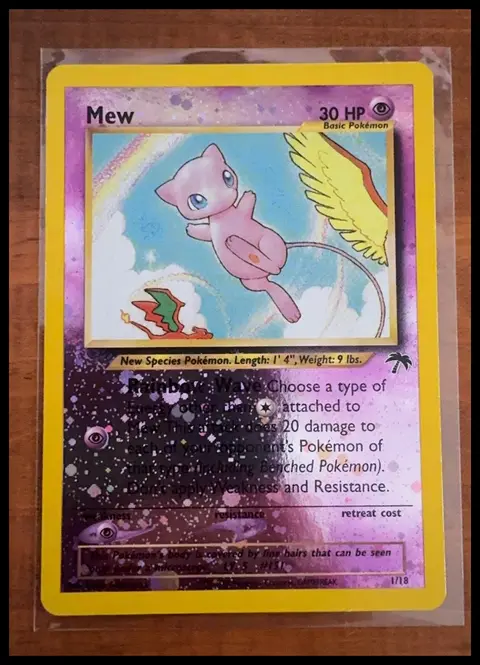
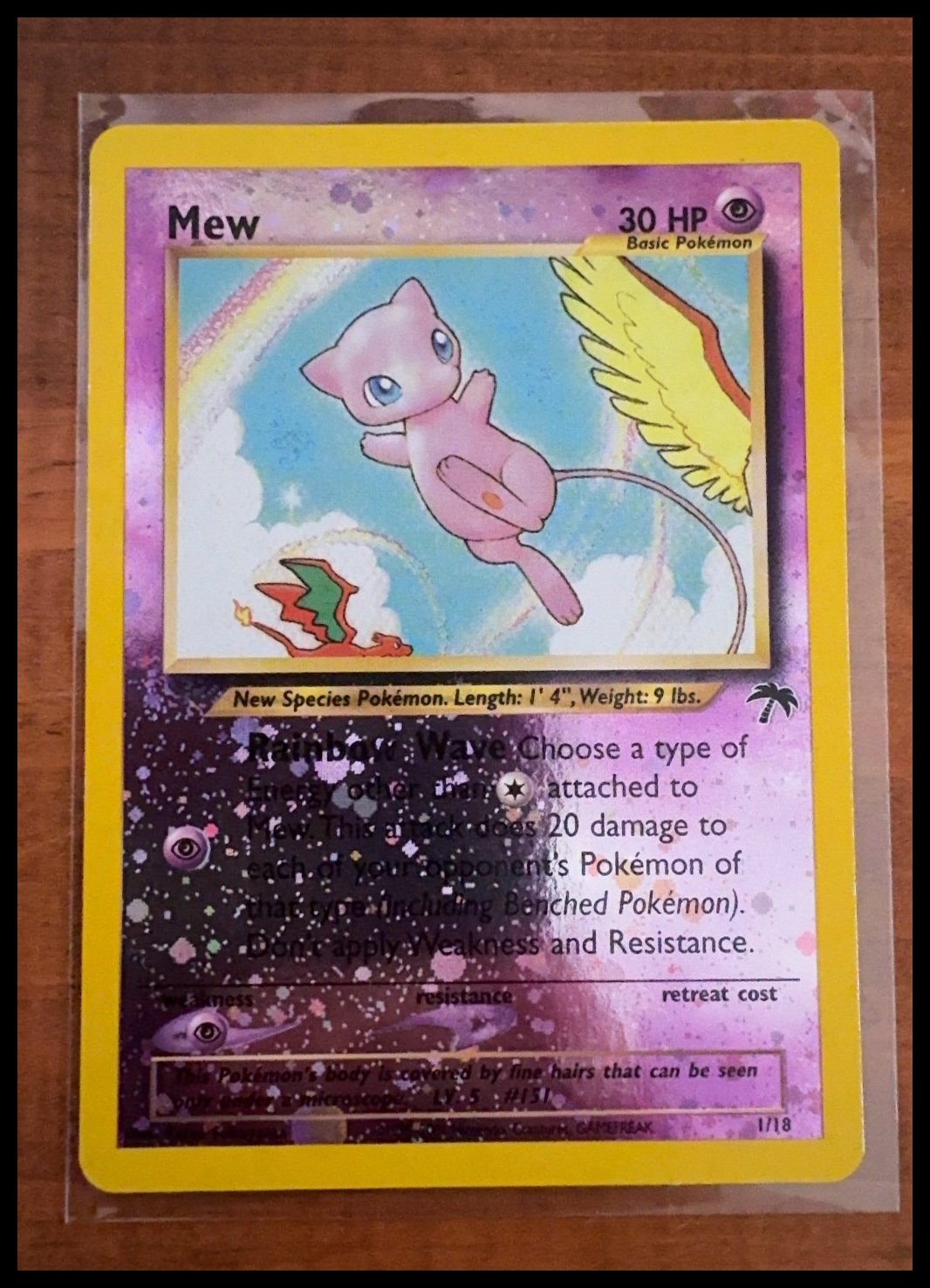
Mew is the Mythical Psychic-type Pokémon numbered 151 in the original Pokédex. In the Pokémon world, Mew is associated with genetic ancestry, rarity, and the ability to learn many Pokémon moves; it is also central to the story of Mewtwo and the Pokémon film Pokémon: The First Movie. This card features artwork by Keiko Fukuyama and depicts Mew with 30 HP.
The English card numbered 1/18 was first released in the Southern Islands collection, a special Pokémon TCG product released in Japan in 2001 and in English on July 31, 2001. The supplied year of 2000 is inconsistent with documented release information; the card is generally cataloged as a 2001 Southern Islands card.
- Mew 1/18 is the first card in the 18-card Southern Islands set.
- Its artwork forms part of the Southern Islands panorama when the set cards are arranged together.
- The card is commonly described as a reverse holofoil or holofoil card, with the foil pattern covering the card background rather than only a dedicated illustration window.
- The card is sometimes incorrectly described as Rare Holo; major price databases classify the Southern Islands printing as a promo or common-set card rather than a standard Rare Holo.
- The card number, artwork, and set identify it as Southern Islands Mew rather than Ancient Mew or another Mew printing.
Rarity and print run
- Tier
- Rare
- Print run
- High
- First printed in
- Pokémon Southern Islands
- Demand
- High
- Supply
- Medium
- The card is from a vintage 18-card special collection rather than a regularly printed expansion.
- High-grade copies are difficult to find because the full-surface reverse holofoil shows scratches, print lines, and handling damage readily.
- Centering, edge whitening, and surface condition strongly separate ordinary copies from premium graded examples.
- Panorama artwork and Mew's popularity create demand beyond the card's formal rarity designation.
Collector notes
Condition. Inspect centering, whitening on the blue border, edge chipping, scratches or print lines in the reverse holofoil, dents, bends, surface scuffs, clouding, and holo scratches. Swirl placement can affect desirability but is not a separate official variant. Check the card for creases, indentation, moisture damage, and evidence of trimming or recoloring. Because the foil background can hide surface defects under some lighting, examine the card under a bright angled light.
Storage. Store in a snug penny sleeve inside a semi-rigid holder or quality card saver, or use a sleeve and appropriately sized top loader. Keep the card upright in a cool, dry, stable environment away from direct sunlight, heat, humidity, pressure, and PVC materials. Avoid stacking heavy objects on top of the card and handle it by the edges.
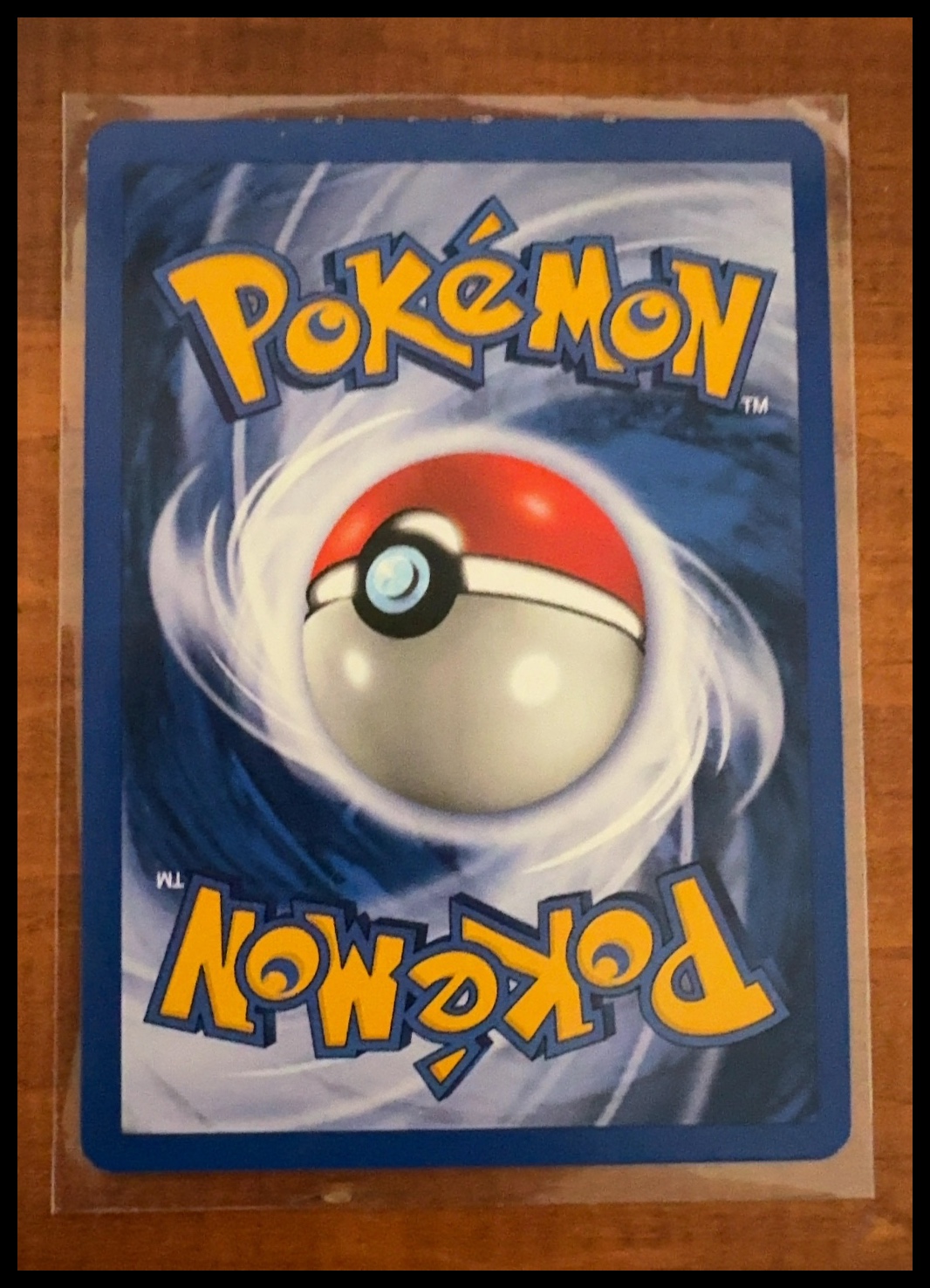
Authenticity. Verify the Southern Islands set identity, 1/18 numbering, Keiko Fukuyama artwork, correct Pokémon font, HP and attack text, border proportions, and reverse holofoil pattern. Compare the card with high-resolution examples and inspect under magnification for incorrect ink dots, blurry text, wrong colors, overly glossy cardstock, an incorrect Pokémon copyright line, or an unusual blue core. The card should not be confused with Ancient Mew, which has different artwork, text, and formatting. For expensive graded examples, verify the grading company certification number and slab details directly with the grading company; professional authentication is recommended for high-value copies.
Sources: pokemoncardscanner.com, pokemoncardvalue.com, pricecharting.com, thelabtcg.com, pokemonwizard.com