Market outlook
Stable Outlook 2/10
The regular English card remains a low-value, readily available Common, and market references cluster near the sub-dollar to low-dollar range. No verified Russian-language sales trend or meaningful scarcity premium is established.
Next months. Over the next 3-6 months, the regular copy is likely to remain broadly stable at a low price. A clean Russian copy could command a premium only when offered to a language-focused or international collector.
Long term. Over 1-3 years, modest appreciation is possible if demand for early XY-era cards or Russian Pokémon cards increases, but substantial growth is unlikely without verified scarcity, strong auction results, or exceptional graded condition.
History
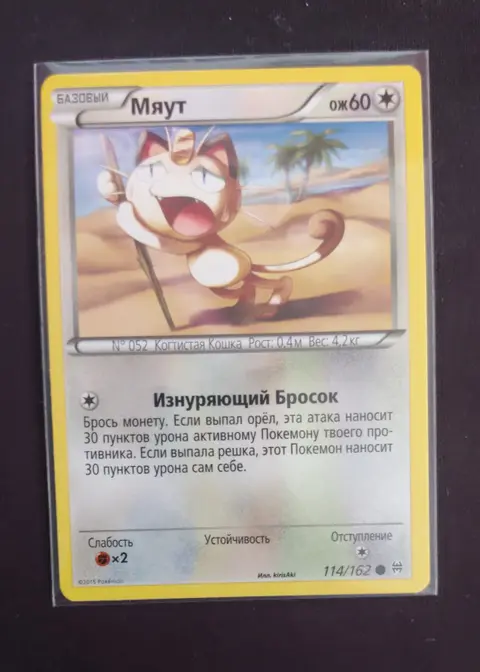
Мяут (Meowth) is a Generation I Pokémon based on a domestic cat, especially the Japanese maneki-neko or beckoning cat. It is known for its ability to produce coins through Pay Day and for its recurring role as a member of Team Rocket in the Pokémon anime. This BREAKthrough card depicts the standard Colorless-type Meowth, not the special regional forms introduced in later generations.
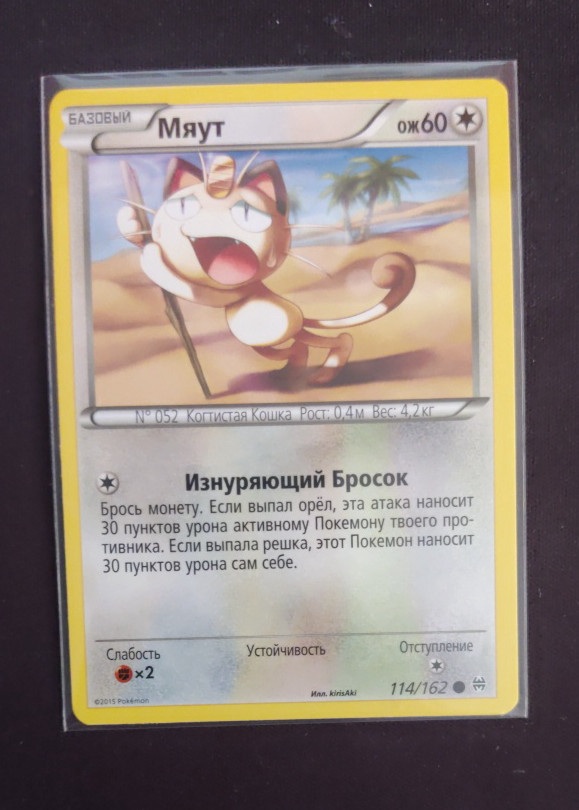
The English version was released in the 2015 Pokémon TCG XY—BREAKthrough expansion. The supplied card is the Russian-language localization of card 114/162; an exact Russian release date and regional distribution record are not clearly documented in the available market sources.
- Card 114/162 is a Basic Pokémon with 60 HP and Common rarity.
- The set is part of the XY Series and contains 162 numbered cards, with some databases counting additional unnumbered cards.
- The regular and Reverse Holo versions share the same card number; the supplied variant is unspecified and should be confirmed from the card surface.
- Market databases identify the card as a reprint of Meowth rather than a debut printing.
Rarity and print run
- Tier
- Common
- Print run
- Very High
- First printed in
- BREAKthrough, 2015, XY Series
- Demand
- Low
- Supply
- Abundant
- Common rarity and a large modern-era print run make the English version widely available.
- The Russian language can create niche scarcity because fewer copies are listed internationally, but listing scarcity does not prove low surviving supply.
- High-grade copies may be less common than raw copies because of centering and handling defects.
- The Reverse Holo version is visually distinct but is not a higher rarity tier.
Collector notes
Condition. Check centering, whitening along the blue back border, edge chipping, surface scratches, dents, print lines, silvering, corner wear, and any bending or creasing. Reverse Holo copies require especially careful inspection for scratches and holo scuffing. Confirm whether the card is regular or Reverse Holo before pricing.
Storage. Store in a clean soft sleeve inside a semi-rigid holder or deck-fitting top loader. Use archival, PVC-free materials; keep cards upright in a cool, dry, temperature-stable location away from sunlight, humidity, pressure, and loose storage. Avoid stacking unsleeved cards.
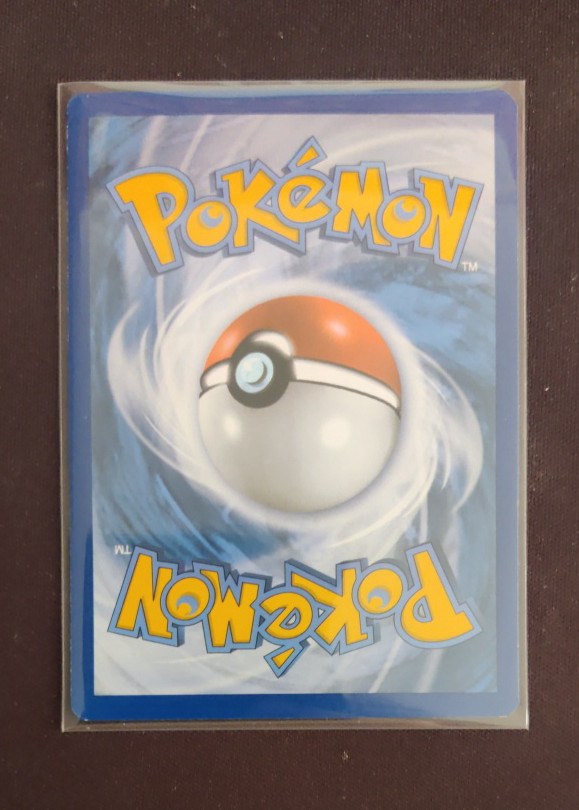
Authenticity. Compare the card with verified XY—BREAKthrough examples for font, set symbol, card number, borders, coloration, Pokémon illustration, and attack text. Genuine Pokémon cards have a layered blue-and-white core visible at a clean cut edge and a consistent Pokémon-back design. Be cautious of unusually thin stock, overly bright or dull colors, incorrect typography, blurry artwork, missing texture or holo pattern, incorrect number formatting, and sellers using stock photos. Russian cards should be checked against an authenticated Russian-language copy because language-specific print quality and text layout differ from English cards.
Sources: pricecharting.com, share.collx.app, cardtrack.com, cardprice.com, monzaptcg.com