Market outlook
Rising Outlook 8/10
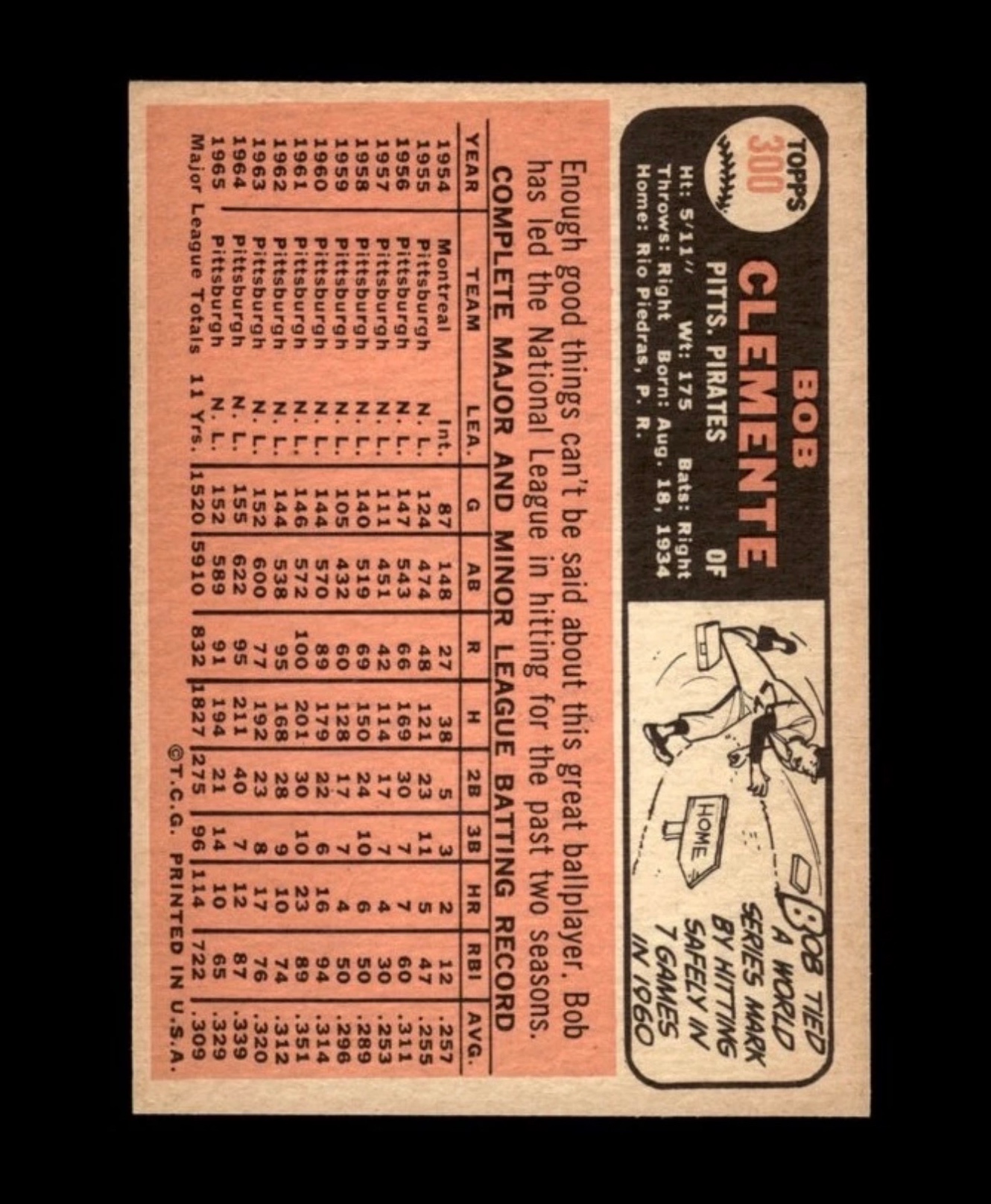
Clemente remains one of the most collected vintage baseball players, and the 1966 Topps #300 is a key issue from his MVP year. Demand for clean, well-centered examples should continue to outpace supply in higher grades.
Next months. Prices should remain firm, with stronger movement in eye-appealing mid- to high-grade copies.
Long term. Likely gradual appreciation over 1-3 years, especially for graded 7+ examples and premium centered copies.
History
Roberto Clemente was a Hall of Fame right fielder for the Pittsburgh Pirates and one of baseball’s most significant figures, remembered for elite all-around play, 3,000 career hits, 12 Gold Gloves, four batting titles, and his humanitarian legacy. His 1966 season was especially notable because he won the National League MVP award, reinforcing the importance of the 1966 Topps #300 card as a key mid-1960s issue for a legendary player.
The card was first released in the 1966 Topps Baseball set, distributed in wax packs and cello/rack products for the 1966 MLB season in the United States.
- Card #300 is one of the key stars in the 1966 Topps Baseball set, alongside names like Willie Mays and Hank Aaron.
- Topps listed him as "Bob Clemente" on the card, a common variation of the era.
- This card comes from Clemente’s 1966 MVP season, which adds strong historical and collector appeal.
- The 1966 Topps set has 598 cards and features a color player photo with a diagonal team banner design.
Rarity and print run
- Tier
- Common
- Print run
- Very High
- First printed in
- 1966 Topps Baseball
- Demand
- High
- Supply
- High
- It was part of a large mainstream Topps base set with broad distribution.
- High-grade copies are meaningfully tougher to find because centering and corner wear are common.
- Collector demand is elevated by Clemente’s status, even though the card itself is not rare.
Collector notes
Condition. Check centering first, as 1960s Topps cards are often heavily off-center. Common issues include corner wear, edge chipping, surface scratches, print spots, and wax staining. The dark borders and bright image area can make wear and registration issues easier to see.
Storage. Store in penny sleeves and semi-rigid holders or top loaders, keep in a cool dry environment, and avoid stacking raw cards without sleeves. For higher-grade copies, use graded holders or submit for encapsulation to preserve value and reduce handling damage.
Authenticity. Authentic cards should show period-correct 1966 Topps stock, print quality, and aging consistent with the era. Watch for modern reprints with overly crisp print, unnatural gloss, or paper that feels too stiff or too bright. Compare the front design, font, and card stock thickness to verified examples, and consider professional grading for expensive copies.
Sources: sportscardspro.com, deanscards.com, oldsportscards.com, waxpackgods.com, sportscardinvestor.com