Market outlook
Stable Outlook 7/10
The card has longstanding collector demand as Bo Jackson's flagship football rookie, but the massive supply keeps raw-card prices from moving sharply. Price strength is most likely to continue in graded 9 and especially graded 10 examples.
Next months. Expect mostly stable pricing with modest fluctuations; high-grade copies should remain the most liquid segment.
Long term. Over 1-3 years, gradual appreciation is likely for strong-condition and slabbed examples, while low-grade raw copies should remain relatively flat.
History
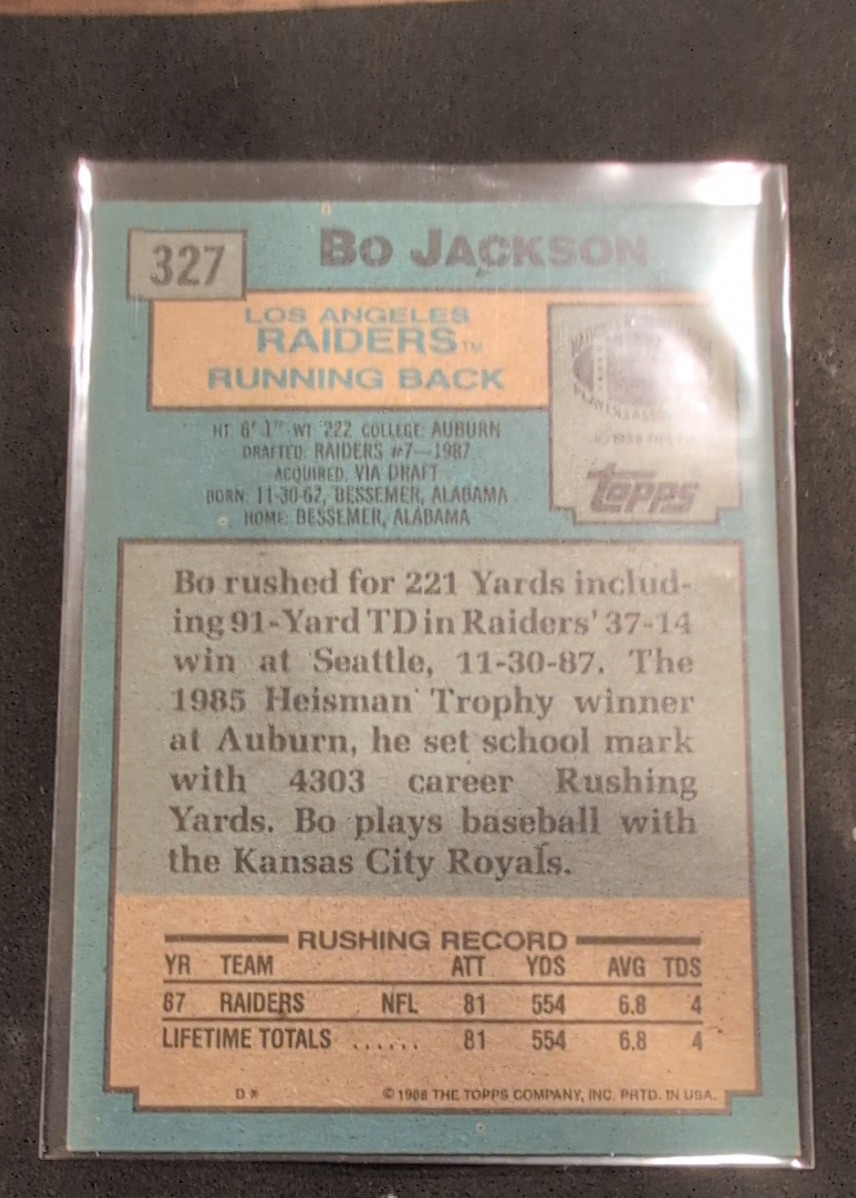
Bo Jackson is Vincent Edward Jackson, a multisport American athlete born November 30, 1962, in Bessemer, Alabama. He became one of the most famous sports figures of the late 1980s and early 1990s as a Heisman Trophy winner, NFL running back for the Los Angeles Raiders, and MLB player, and he is widely remembered as one of the greatest athletic talents ever to appear on a football card.
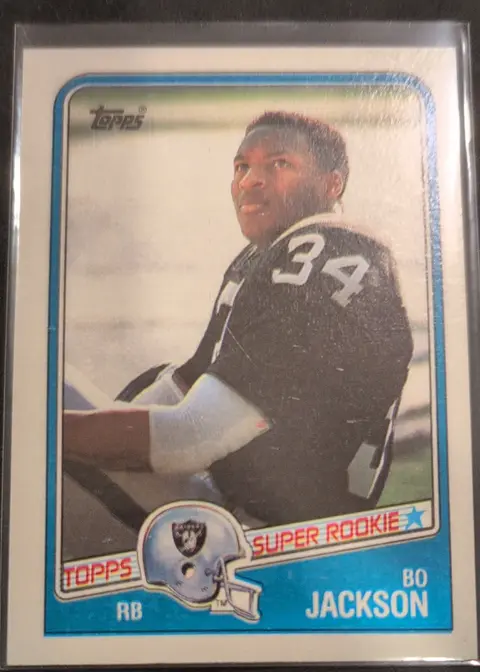
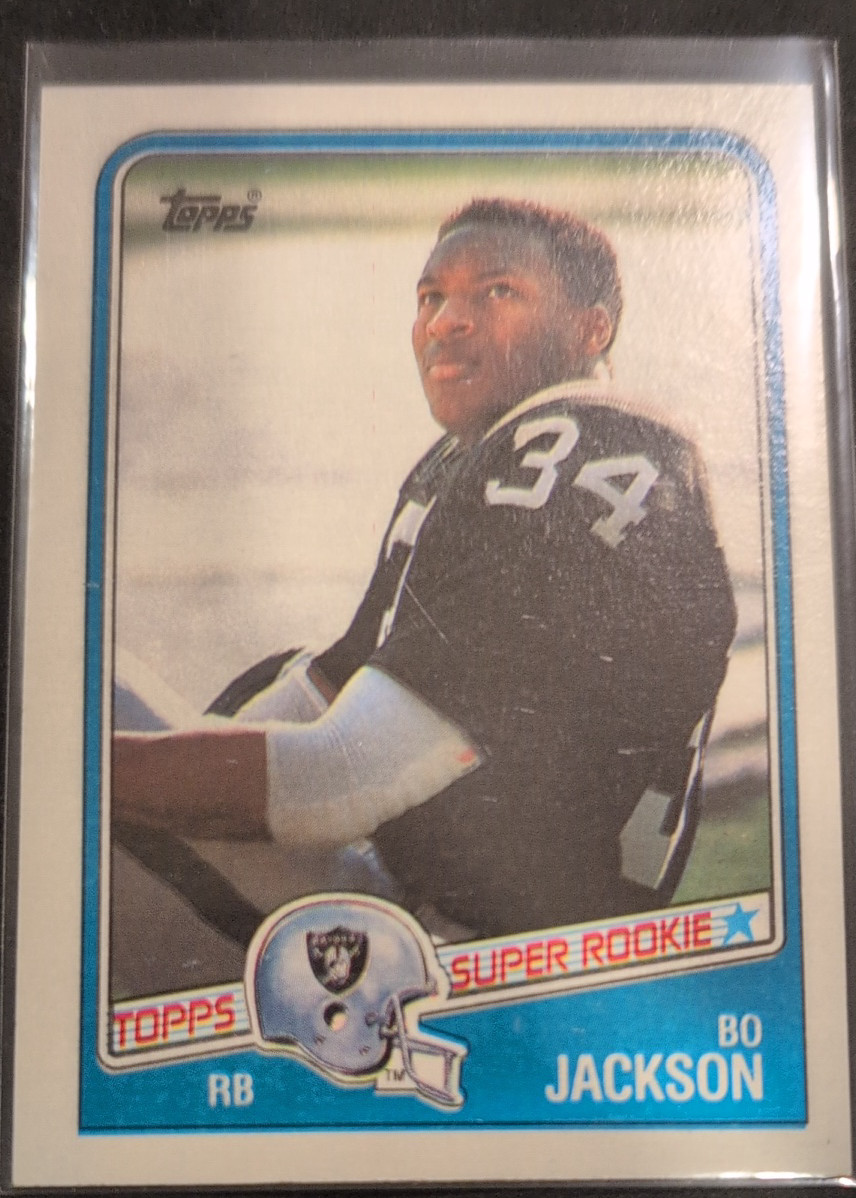
First released in the 1988 Topps Football set in 1988 in the United States; card #327 is widely identified as Bo Jackson's rookie card in that set.
- Widely treated as Bo Jackson's flagship football rookie card in 1988 Topps.
- The card is commonly labeled 'Super Rookie' on marketplaces and hobby sites.
- It is one of the most recognizable and heavily collected base rookie cards from the late-1980s football market.
Rarity and print run
- Tier
- Common
- Print run
- Very High
- First printed in
- 1988 Topps Football
- Demand
- High
- Supply
- Abundant
- Base-set production was very large, making raw copies easy to find.
- High-grade examples are meaningfully scarcer because centering and corner wear reduce gem-mint survival.
- Demand is driven more by player popularity and rookie-card status than by true pack-level rarity.
Collector notes
Condition. Check centering carefully, especially left-to-right and top-to-bottom. Common issues include soft corners, edge whitening, surface print lines, and mild wear from bulk storage or pack handling. Because it is a mass-produced common card, high-grade copies are far more desirable than raw examples with visible wear.
Storage. Store in a penny sleeve and rigid holder or semi-rigid card saver, then keep in a cool, dry, dark environment. For long-term preservation, avoid rubber bands, loose boxes without dividers, and direct sunlight; use graded/graded/graded submission-ready sleeves if grading is planned.
Authenticity. Counterfeits are less common than with vintage icons but still possible, especially for altered or rebacked copies sold online. Verify correct 1988 Topps stock, print quality, color consistency, and card stock thickness; compare against known authentic examples and prefer graded cards or trusted sellers for higher-value copies.
Sources: sportscardspro.com, ebay.com, psacard.com, sportscardinvestor.com, sportscollectibles.com