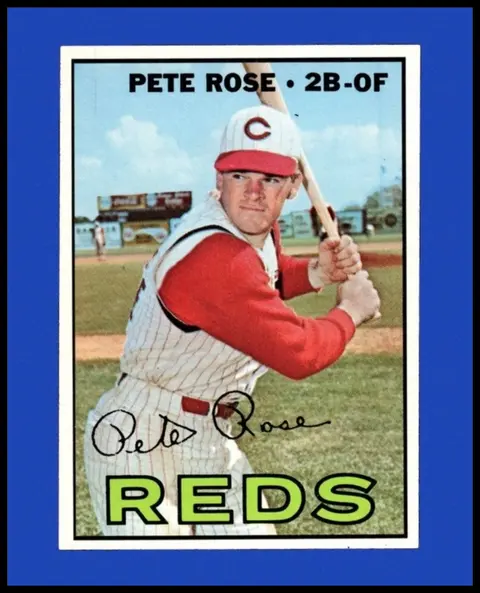
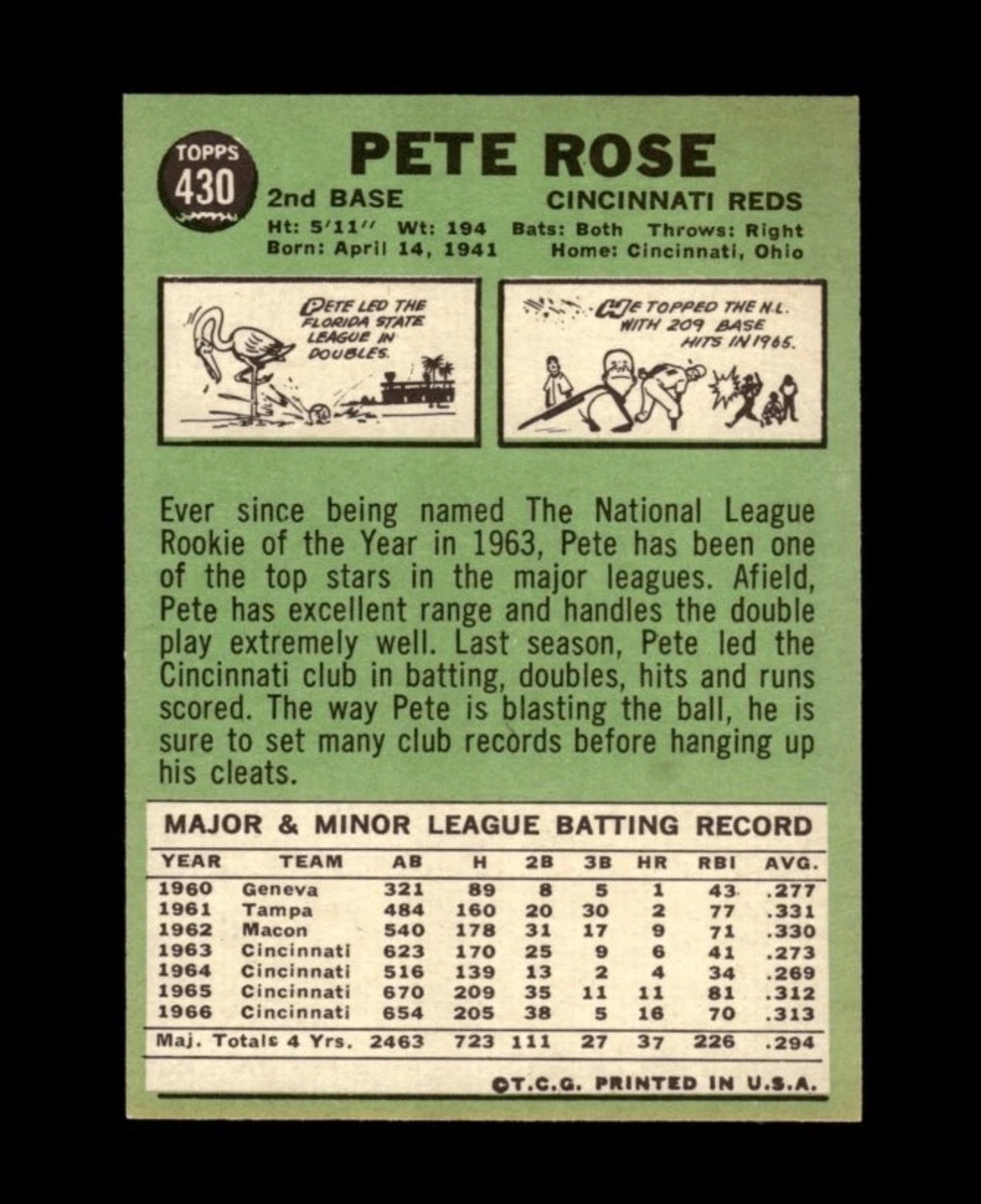
Market outlook
Stable Outlook 7/10
The card's high supply and Pete Rose's controversial legacy create a stable but not rapidly rising market. High-grade copies (graded 9) show slight upward momentum due to collector interest in premium versions of iconic players.
Next months. Next 3–6 months: Prices for graded 9 copies may rise slightly (~2–5%) due to continued collector interest; lower grades remain flat.
Long term. 1–3 years: Stable growth for high-grade copies; overall market remains flat due to abundant supply in lower grades. No major surge expected unless Rose's legacy is re-evaluated.
History
Pete Rose was a legendary American baseball player who played 24 seasons in Major League Baseball, primarily for the Cincinnati Reds. Known as 'Charlie Hustle,' he was the all-time leader in games played (3,562), total at-bats (14,053), and plate appearances (15,890). Rose won four National League batting titles and the 1963 NL MVP award, and he was a key figure in the Reds' 1975 World Series championship. His career was later marred by his 1990 suspension for gambling on baseball, which led to his permanent ban from the sport and exclusion from the Hall of Fame.
This card was first released in 1967 as part of the Topps Baseball series in the United States.
- Pete Rose held the all-time MLB record for games played for decades.
- He was the NL MVP in 1963 and won four batting titles.
- Rose was banned from baseball in 1990 due to gambling violations.
Rarity and print run
- Tier
- Common
- Print run
- Very High
- First printed in
- 1967 Topps Baseball
- Demand
- Medium
- Supply
- Abundant
- Massively printed as a common card in the 1967 Topps set
- High survival rate due to popularity and widespread distribution
- Not traditionally difficult to find in lower grades
Collector notes
Condition. Key things to check include centering, edge wear, corner wear, and surface scratches. Common flaws for 1967 Topps cards include soft corners, print lines, and off-centering. The white borders are prone to yellowing or staining over time.
Storage. Store the card in a hard plastic protector (like a top loader) and keep it in a climate-controlled, dry environment away from direct sunlight. Use a card sleeve before placing it in the top loader to prevent abrasion.
Authenticity. Fakes or reprints can be spotted by examining the paper stock, which should match the original 1967 texture and weight. Original cards have a distinct matte finish, while reprints often appear overly glossy. Verify the graded or grading label authenticity through the grading company's database using the certification number.
Sources: steinersports.com, psacard.com, sportscardinvestor.com, sportscardspro.com, deanscards.com