Market outlook
Stable Outlook 7/10
Demand for Clemente remains consistently strong, but the card is widely available in lower grades, which tends to keep prices stable rather than sharply rising in the short term.
Next months. Expect mostly stable pricing with occasional spikes for exceptional eye appeal or top-graded examples.
Long term. Likely gradual appreciation over 1-3 years, especially for graded 8 and above, driven by Clemente’s enduring popularity and the limited supply of elite-condition 1960s cards.
History
Roberto Clemente was a Hall of Fame right fielder for the Pittsburgh Pirates, one of the most important Latin American players in Major League Baseball history. Born in Puerto Rico, he became a 12-time All-Star, 12-time Gold Glove winner, 4-time batting champion, and the first Latin American player to reach 3,000 hits; he is also remembered for his humanitarian work and died in a 1972 plane crash while delivering aid to earthquake victims in Nicaragua.
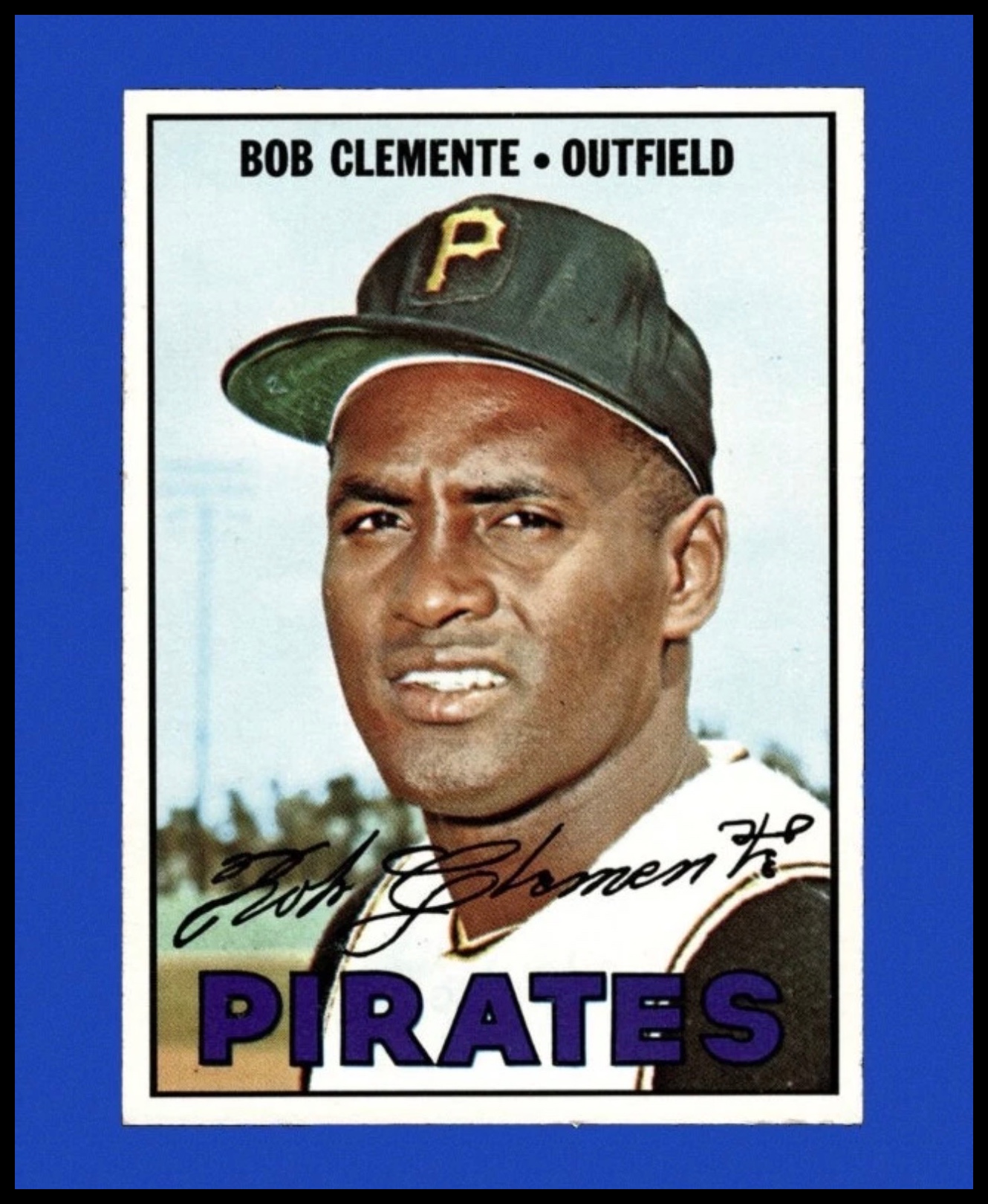
The card was first issued in the 1967 Topps Baseball set, released by Topps in 1967 for the U.S. baseball card market.
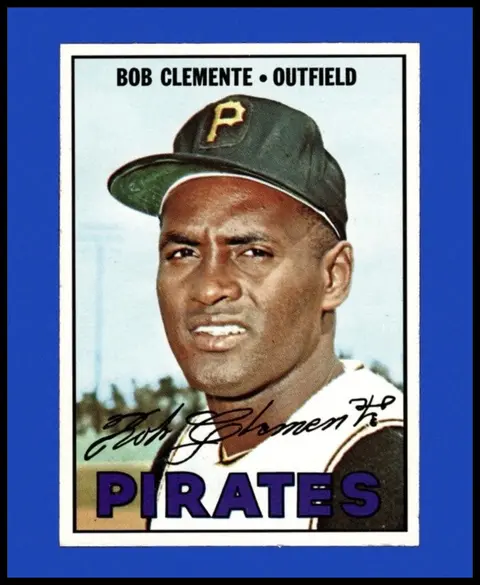
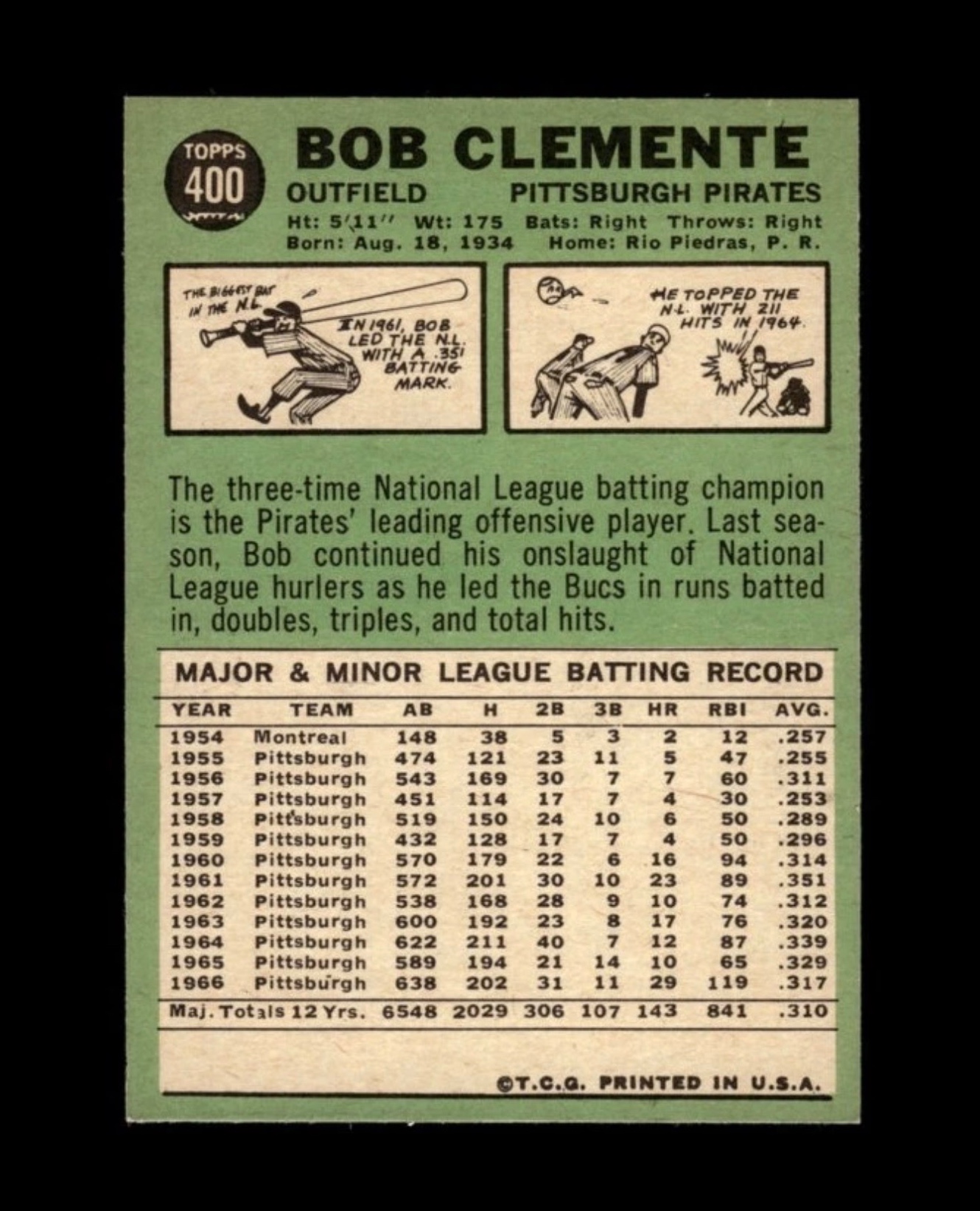
- Card number 400 in the 1967 Topps Baseball set, featuring Roberto Clemente of the Pittsburgh Pirates.
- High-grade examples remain actively traded, with a graded 8 copy last reported at $835 on 7/24/2025 and a graded 8.5 Heritage auction result at $650.
- Listings and auction examples show the card is commonly collected in graded form across a wide condition spectrum, from graded 1 up through high-grade copies.
Rarity and print run
- Tier
- Common
- Print run
- Very High
- First printed in
- 1967 Topps Baseball
- Demand
- High
- Supply
- Medium
- The card comes from a high-print 1967 Topps flagship baseball set, so raw supply is not inherently rare.
- High-grade copies are harder to find because centering, corner wear, and print defects are common on 1960s Topps cards.
- Roberto Clemente’s long-term demand increases collector interest even though the base card itself is not rare.
Collector notes
Condition. Check for centering, corner wear, edge chipping, surface scratches, print snow, wax staining, and roller marks. On 1960s Topps cards, poor centering is especially common and can strongly affect grade and value.
Storage. Store in a penny sleeve and rigid top loader or semi-rigid holder, keep the card in a cool, dry, low-light environment, and avoid handling the surface with bare fingers. For long-term preservation, use archival-quality materials and avoid PVC plastics.
Authenticity. Authentic 1967 Topps cards should show period-correct print quality, card stock, and aging consistent with a 1960s Topps issue. Be cautious of overly bright colors, suspiciously sharp edges, or modern paper stock; grading company certification is the best protection against reprints and altered cards.