Market outlook
Stable Outlook 7/10
Demand for Hall of Fame vintage stars remains consistent, but the card already has an established market and is more likely to move with broader vintage baseball trends than to experience sharp category-specific spikes. High-grade supply is thin, which supports prices, while lower-grade copies remain relatively available.
Next months. Prices should remain mostly stable with occasional strength in well-centered or high-grade examples.
Long term. Expect gradual appreciation, especially for graded 8 and above, with the strongest gains likely in population-scarce high-grade copies.
History
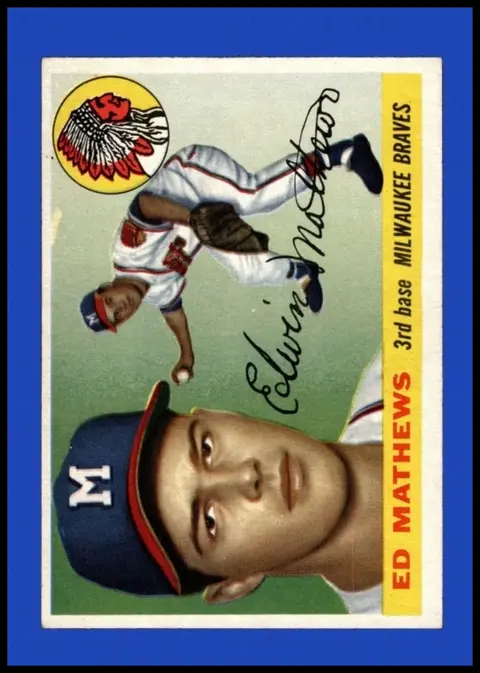
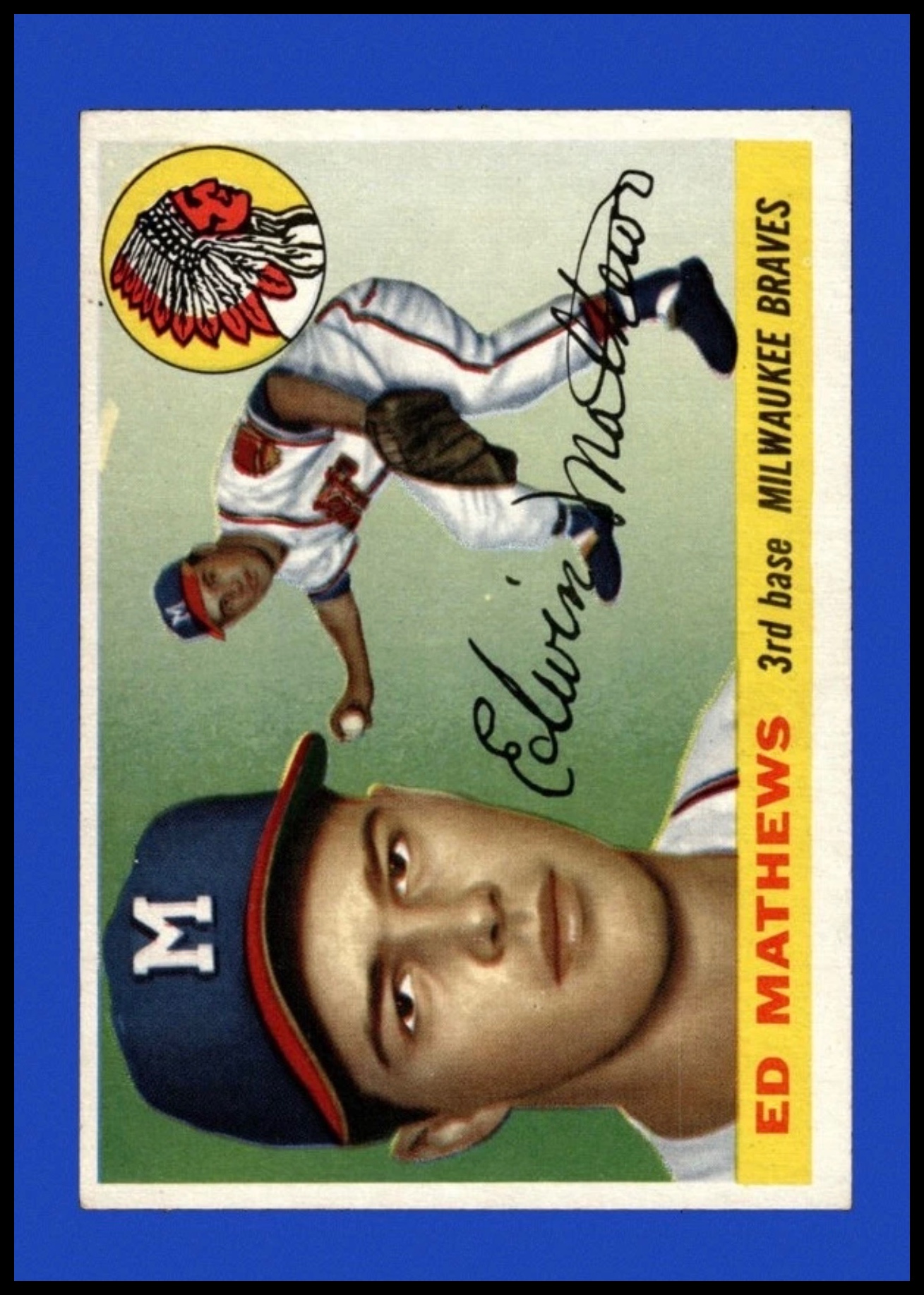
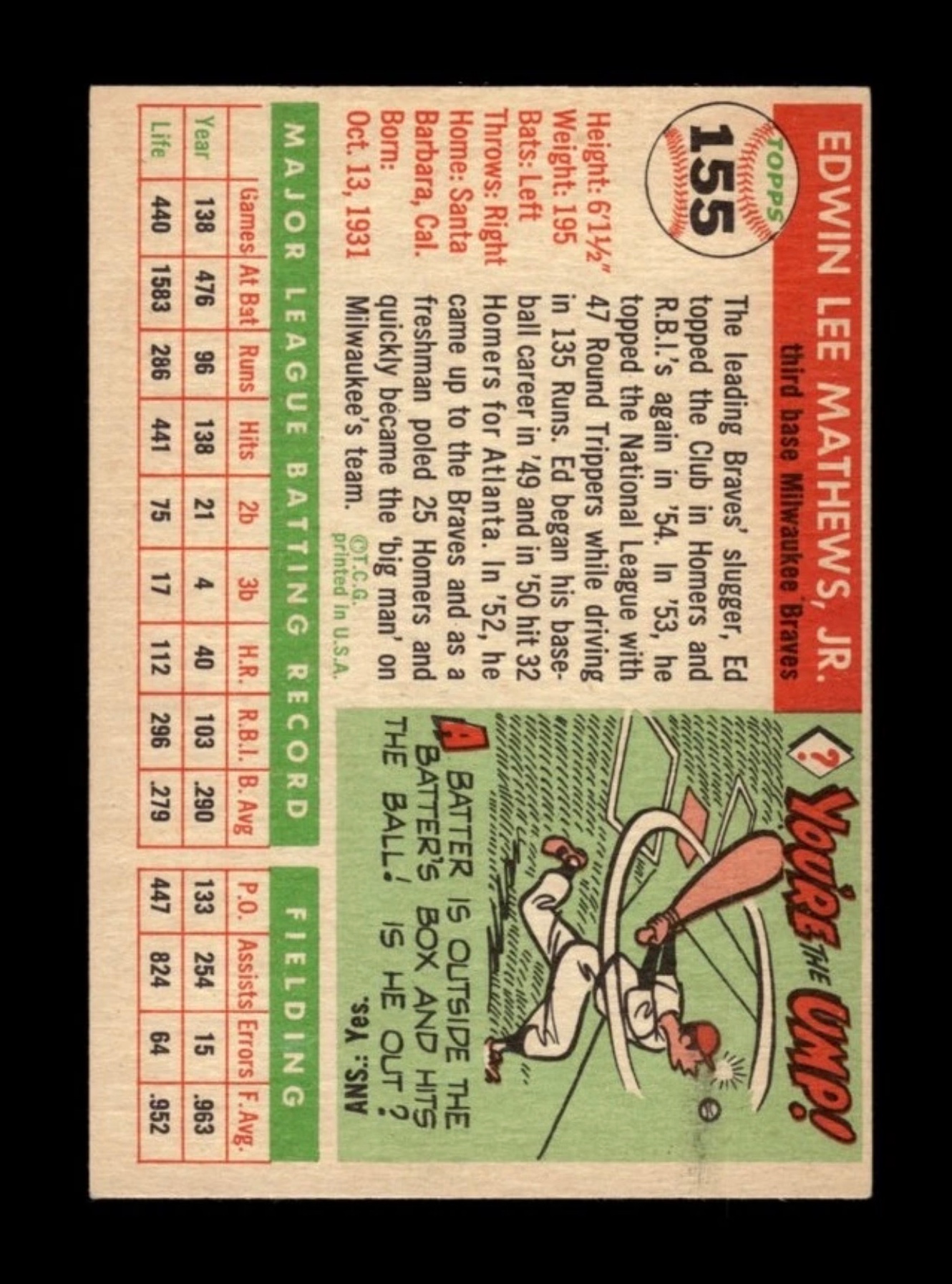
Eddie Mathews (Edwin Lee Mathews) was one of the premier power hitters of his era and the only player to play for the Braves in Boston, Milwaukee, and Atlanta. He debuted in 1952, became a cornerstone of the Milwaukee Braves, and finished his career with 512 home runs, 2,315 hits, 1,509 runs, 1,453 RBI, and a .271 batting average. His Hall of Fame career and status as a franchise icon make the 1955 Topps card one of the key mid-1950s cards of a future inner-circle slugger.[1]
First released in the 1955 Topps Baseball set, distributed in the United States in 1955 as part of Topps' regular-season baseball card issue.[1][4]
- This card is numbered #155 in the 1955 Topps Baseball set and is one of the set's important star-player cards.[1][4]
- graded CardFacts shows a high-end condition census led by a graded MINT 9, indicating strong collector interest at the top of the market.[1]
- Auction records and price guides show the card has meaningful value even in lower grades, with prices rising steeply in higher Mint and Near Mint examples.[1][3][4][5]
Rarity and print run
- Tier
- Common
- Print run
- High
- First printed in
- 1955 Topps Baseball
- Demand
- High
- Supply
- Medium
- It comes from a mass-produced flagship Topps issue, so the card itself is not rare.
- Higher-grade copies are much scarcer because centering and corner wear are difficult on 1955 Topps stock.[1]
- The card's market scarcity is grade-driven rather than print-run-driven.
Collector notes
Condition. Check centering carefully, especially left-right and top-bottom alignment, along with corner wear, edge chipping, surface scuffs, print snow, and color loss. Because 1955 Topps cards are wood-grain style, wear along the borders and natural paper discoloration are common, and eye appeal can vary widely even within the same grade. Focus on whether the portrait and name area remain clean and whether any paper loss appears along the edges.
Storage. Store in a penny sleeve and rigid holder or semi-rigid card saver, then keep in a cool, dry, low-light environment with stable humidity. Avoid PVC materials, direct sunlight, and repeated handling without clean hands or gloves. For higher-grade copies, slabbed encapsulation is often the safest long-term protection.
Authenticity. Authentic examples should match the period-correct 1955 Topps stock, printing quality, and wood-grain border design. Watch for overly sharp modern printing, unnatural color saturation, incorrect stock thickness, and edge patterns that look cut by modern equipment. Reprints often have clearer or flatter printing, different paper texture, or mismatched aging compared with a genuinely circulated 1950s card.
Sources: psacard.com, steinersports.com, sportscardinvestor.com, sportscardspro.com, sports.ha.com