Market outlook
Stable Outlook 7/10
Demand is anchored by character popularity and set importance, but the card already has broad recognition and active supply, which tends to moderate rapid price appreciation unless a new wave of One Piece collector interest emerges.
Next months. Likely to trade in a relatively tight range, with spikes possible for graded high-end copies and clean raw copies.
Long term. Gradual appreciation is plausible for top-grade or highly desirable variant copies, especially if One Piece collector demand continues expanding, but standard copies are more likely to remain range-bound.
History
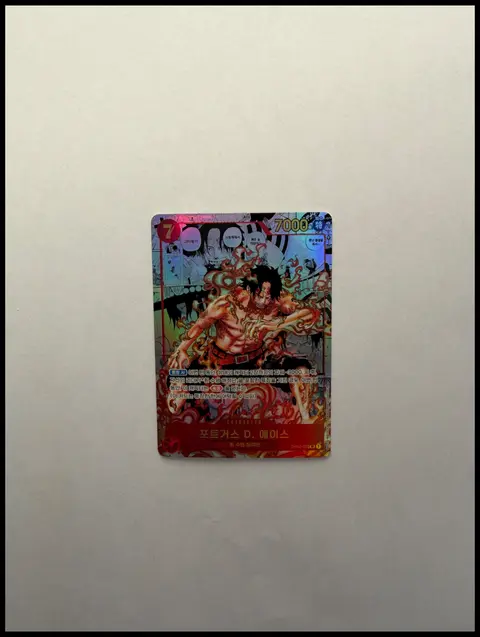
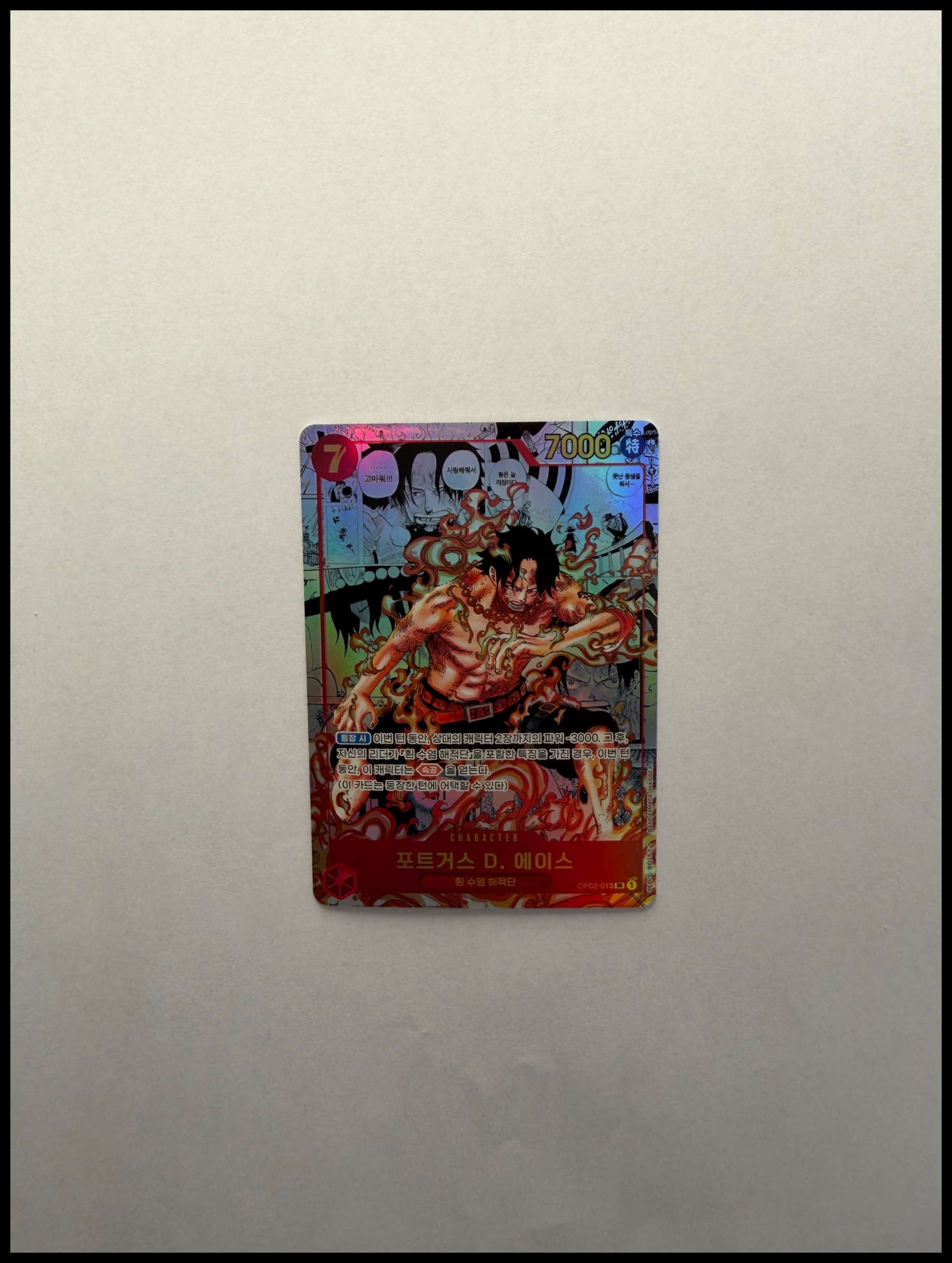
Portgas D. Ace is a major character from Eiichiro Oda's One Piece, serving as the adopted older brother of Monkey D. Luffy and Sabo and the biological son of the late Pirate King, Gol D. Roger, and Portgas D. Rouge. He is known as 'Fire Fist' Ace, the former 2nd Division Commander of the Whitebeard Pirates, and one of the most emotionally significant figures in the series due to his role in the Marineford/Paramount War arc. This card depicts him in a highly collectible manga/alternate-art style tied to that iconic storyline.
First released in Japan in the One Piece Card Game Paramount War set (OP-02) in 2022, under card number OP02-013; the Korean-language printing would have followed as part of the localized Korean release of the same set.
- OP02-013 is a Super Rare (SR) Portgas D. Ace card from the Paramount War set.
- This card is one of the most desirable Ace cards because the character is tied to one of the most famous story arcs in One Piece.
- Marketplace and grading listings identify manga/alternate-art versions of this card as especially high-value compared with the standard SR printing.
Rarity and print run
- Tier
- Rare
- Print run
- High
- First printed in
- Paramount War (OP-02)
- Demand
- High
- Supply
- Medium
- Super Rare classification makes it scarcer than bulk cards but not among the hardest chase tiers.
- Full-art and manga/alternate-art presentation increases collector demand beyond the base SR version.
- Character popularity and iconic storyline association create strong secondary-market competition.
- Korean-language copies may be scarcer in some collector circles than Japanese copies, depending on regional demand.
Collector notes
Condition. Check for edge whitening, corner wear, surface scratches, print lines, centering, and foil/texture wear, especially on full-art and alternate-art surfaces. Korean cards can also show minor factory edge chipping, visible scuffs under light, and binder-related pressure marks. Because this is a character card with strong demand, even light defects can affect value materially.
Storage. Store in a penny sleeve and rigid top loader or semi-rigid holder, ideally with a perfect-fit sleeve for extra protection. Keep away from heat, humidity, UV light, and direct handling; use clean gloves if inspecting raw copies. For graded or intended-grade copies, minimize movement and avoid any cleaning attempts.
Authenticity. Verify correct set code OP02-013, language, card stock, texture/foil pattern, and print sharpness. Counterfeits often show blurry text, incorrect color saturation, flat or wrong foil behavior, and poor edge cutting. For high-value copies, compare to authenticated exemplars from major grading-company pop reports and sales images; Korean-language fakes are less common than Japanese/English but still possible if the card is in a premium variant.
Sources: cardladder.com, sportscardinvestor.com, aamintcards.com, pricecharting.com, psacard.com