Market outlook
Rising Outlook 7/10
The card benefits from steady Hall of Fame star demand, rookie-era significance, and increasing collector focus on condition-sensitive vintage basketball. Price guides show ongoing movement, and high-grade examples remain especially sought after.[3][4]
Next months. Expect stable to modestly higher prices for clean raw and graded copies, with stronger movement in graded 8 to graded 10 territory.
Long term. Over 1-3 years, the card should continue to appreciate gradually, especially in top grades, though broad-market gains may remain uneven because supply is plentiful.
History
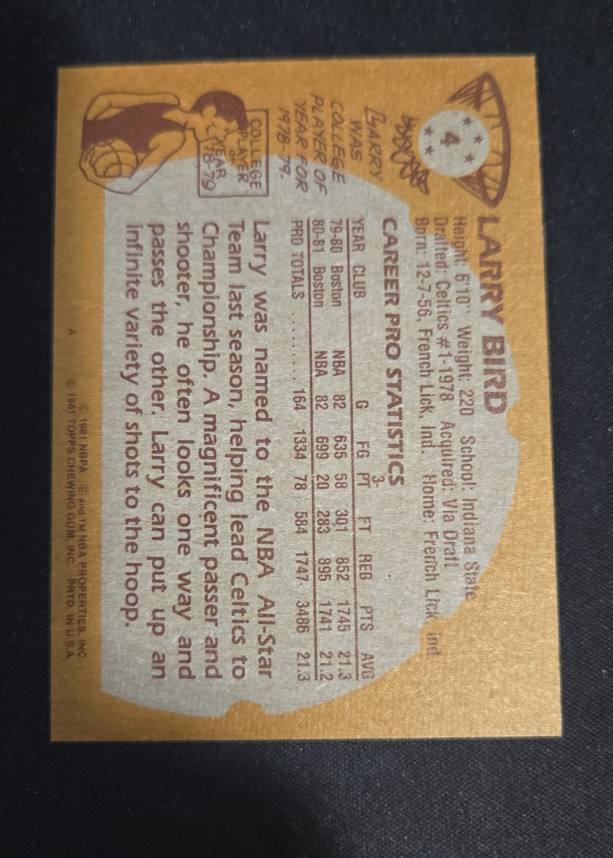
Larry Bird is one of the defining figures in NBA history, known for transforming the Boston Celtics into a championship powerhouse and becoming one of the league’s most iconic small forwards. By the time of this 1981 Topps issue, Bird had already won NBA Rookie of the Year and was emerging as a central star of the Celtics’ 1980s dynasty; he was later inducted into the Naismith Memorial Basketball Hall of Fame. graded notes Bird finished his career with 21,791 points, 8,974 rebounds, 5,695 assists, 649 three-pointers, and 1,556 steals.[1]
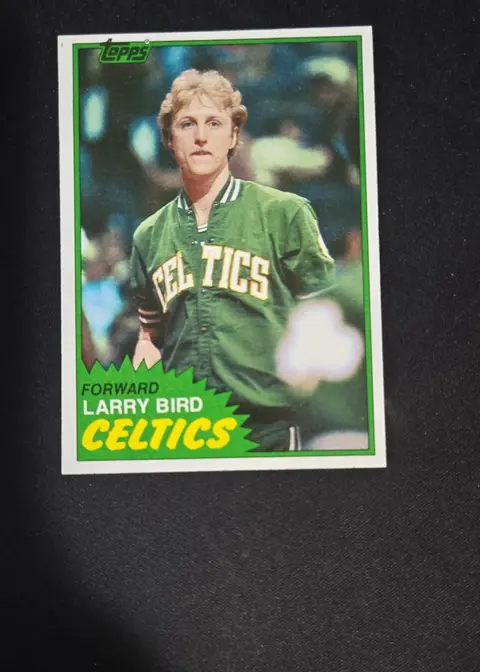
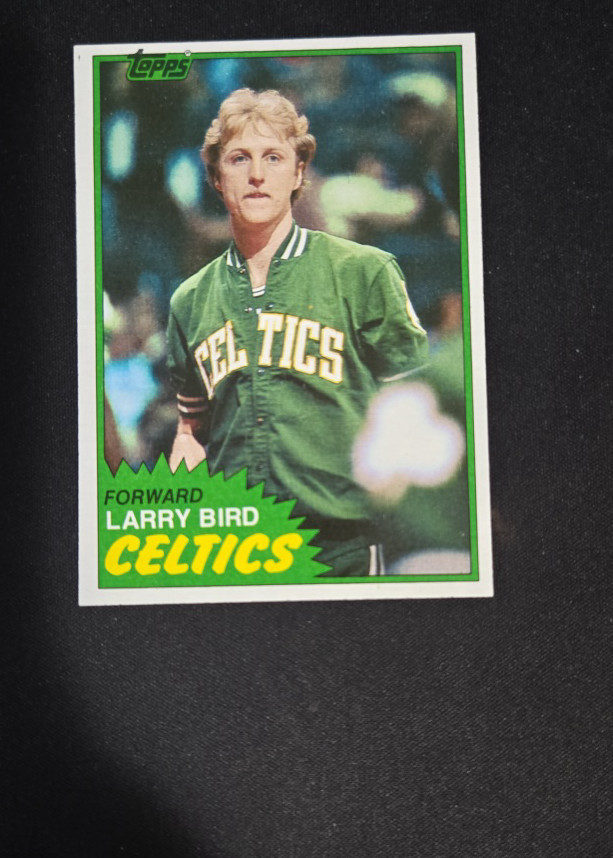
This card was first released in the 1981 Topps Basketball set, distributed in the United States by Topps in 1981. Sports Card Investor identifies it as Larry Bird’s 1981 Topps #4 base card, and graded lists it as 1981 Topps Basketball #4.[3][4][5]
- This is widely treated as Larry Bird’s first solo Topps card, following his shared rookie-era appearance in 1980 Topps with Magic Johnson and Julius Erving.[2]
- Collectors often describe it as Bird’s first full-card Topps appearance, which is a major reason for its long-term demand.[2]
- graded price data shows strong grade sensitivity, with graded 10 examples far more valuable than lower grades, reflecting continued collector interest in high-grade copies.[1][3]
Rarity and print run
- Tier
- Common
- Print run
- Very High
- First printed in
- 1981 Topps Basketball
- Demand
- High
- Supply
- High
- The base set itself was mass-produced, so the card is not rare in an absolute sense.
- High-grade copies are relatively harder to find because centering and corner quality are often weak.
- Demand is elevated because this is Bird’s first full solo Topps card, which increases perceived importance.
Collector notes
Condition. Centering is the biggest issue, followed by corner wear, edge chipping, surface scratches, and print defects common to early-1980s Topps cards. Because this is a popular star card, high grades are disproportionately valuable, so slight whitening or off-centering can materially affect price.[1][3]
Storage. Store it in a penny sleeve and rigid top loader or semi-rigid holder, then keep it in a cool, dry, low-light environment. For higher-value copies, submit to professional grading and avoid repeated handling, since centering and corner wear are the most price-sensitive flaws.[1][3]
Authenticity. Authentic examples should match the standard 1981 Topps design, stock, printing quality, and card stock texture. Watch for reprints with overly sharp modern print dots, incorrect gloss, or unnatural white borders; graded examples from major third-party graders are the safest option for high-value copies.[5]
Sources: psacard.com, youtube.com, sportscardspro.com, sportscardinvestor.com, blog.vintagebreaks.com